Cardiovascular · CARDIOVASCULAR

Antiplatelet agents

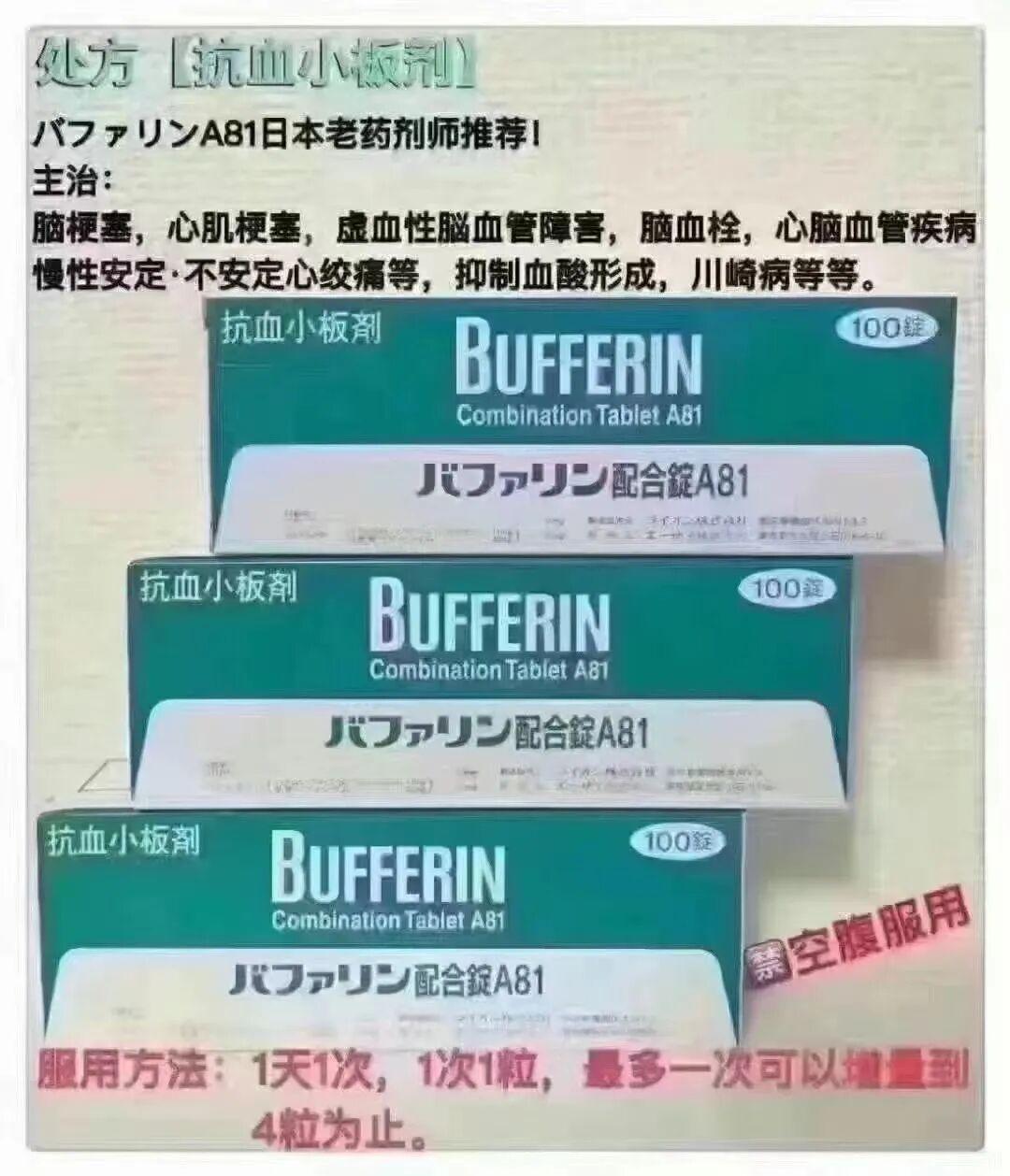
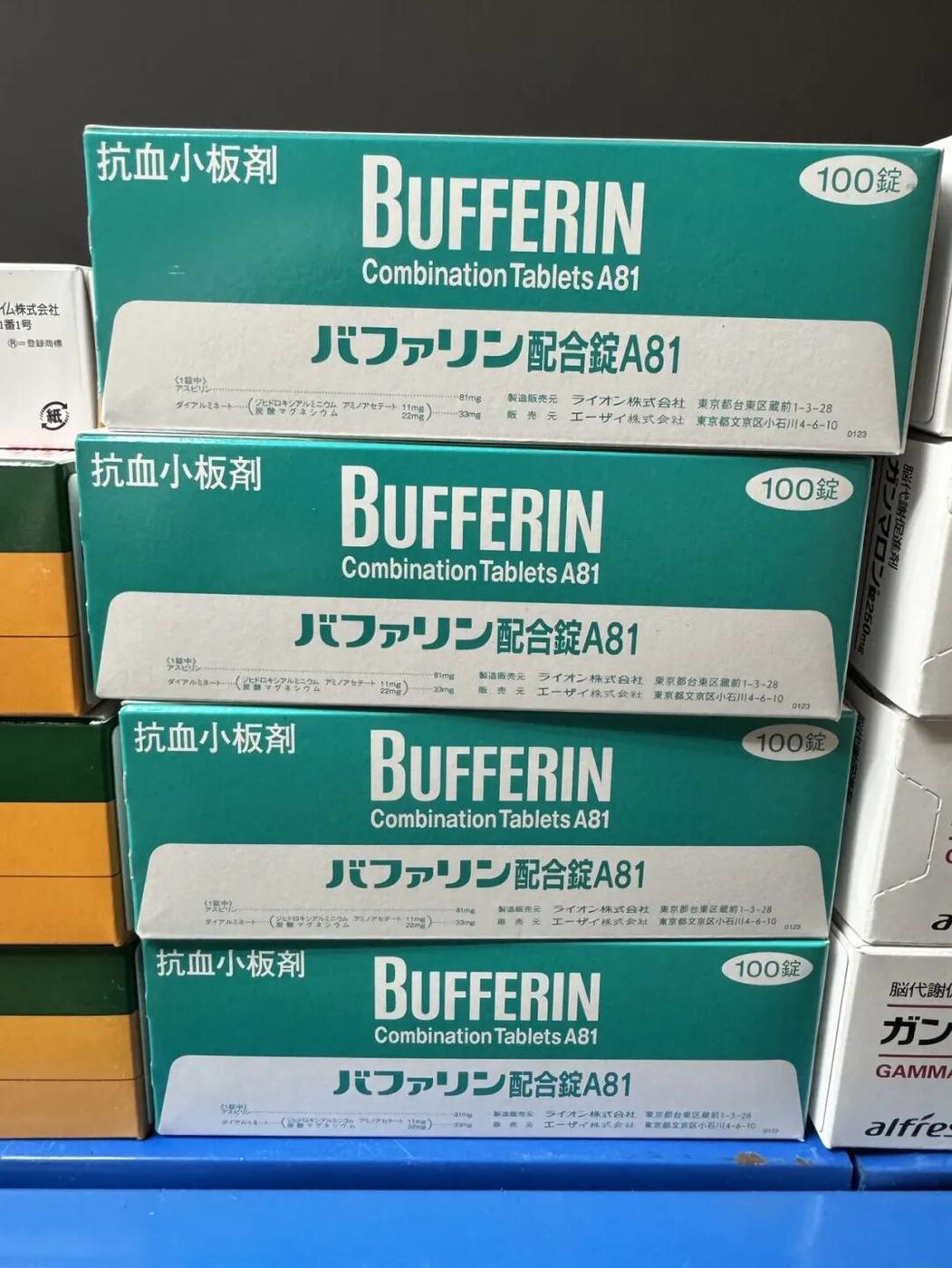
日本語原題:バファリン配合錠A81

Published2025-04-25 11:57 FormTablet Content9 sections / 2 images Japanese nameバファリン配合錠A81
Ingredients / strength:
Active ingredients: per tablet, aspirin 81mg, dialuminate (dihydroxy aluminum, aminoacetate 11mg, and magnesium carbonate 22mg) 33mg. Additives: cornstarch, saccharin, saccharin sodium hydrate, talc, D-mannitol, gelatin, yellow No. 5 aluminum rake, fragrance.
English translation of the Japanese package insert is the main text; the Japanese original is shown alongside for verification. Use the language menu (top right) to read the page in another language. This site is for reference only — consult a doctor or pharmacist before use.
Section 1 · Feature description
English translation
Aspirin irreversibly inhibits platelet cyclooxygenase through its acetyl group, suppressing the production of thromboxane A2 (TXA2) on platelets, thereby suppressing platelet aggregation and preventing the formation of platelet thrombosis. On the other hand, salicylic acid, the main metabolite of aspirin, exhibits anti-inflammatory effects comparable to aspirin but does not inhibit platelet aggregation. Aspirin also inhibits cyclooxygenase in vascular endothelial cells, thereby suppressing the production of prostacyclin (PGI2), which has been suggested to weaken its platelet aggregation inhibitory effect (the aspirin dilemma). Therefore, oral administration of low-dose aspirin (75mg/day~325mg/day) is recommended.
Section 2 · Specifications
English translation
100 tablets [10 tablets (SP packaging)×10].
Section 3 · Characteristics
English translation
Light orange plain tablets (double-layer tablets) with an orange fragrance.
Section 4 · Ingredient Description
English translation
Active ingredients: per tablet, aspirin 81mg, dialuminate (dihydroxy aluminum, aminoacetate 11mg, and magnesium carbonate 22mg) 33mg. Additives: cornstarch, saccharin, saccharin sodium hydrate, talc, D-mannitol, gelatin, yellow No. 5 aluminum rake, fragrance.
Section 5 · Functions and indications
English translation
1. Suppression of thrombosis and embolism formation in the following diseases (1) Angina pectoris (chronic stable angina, unstable angina) (2) Myocardial infarction (3) Ischemic cerebrovascular injury (transient ischemic attack (TIA), cerebral infarction) 2. Suppression of thrombus and embolic formation after coronary artery bypass graft (CABG) or percutaneous transcatheter coronary angioplasty (PTCA) 3. Kawasaki disease (including cardiovascular sequelae caused by Kawasaki disease)
Section 6 · Usage and dosage
English translation
1. When used to suppress thrombus and embolization in angina (chronic stable angina, unstable angina), myocardial infarction, ischemic cerebrovascular disorders (transient ischemic attack (TIA), cerebral infarction), and to suppress thrombus and embolism after coronary artery bypass graft (CABG) or percutaneous transcatheter coronary angioplasty (PTCA)〉 Typically, adults are given one tablet (81mg as aspirin) orally once daily. Depending on symptoms, the dose can be increased up to 4 tablets per dose (324mg as aspirin). 2. When used for Kawasaki disease (including cardiovascular sequelae caused by Kawasaki disease) During the acute febrile phase, 30~50 mg per 1 kg of body weight per day is administered orally as aspirin, divided into three doses. From the recovery phase after fever reduction to the chronic phase, aspirin is administered orally once at 3~5 mg per 1 kg of body weight per day. Adjust the amount appropriately according to symptoms.
Section 7 · Important notes
English translation
1. When administering to patients with cerebral infarction, pay attention to interactions with other drugs that suppress platelet aggregation, and use with caution in patients with persistent hypertension. Ensure adequate blood pressure control during administration. 2. For long-term administration, perform regular clinical tests (urine tests, blood tests, liver function tests, etc.). Also, if abnormalities are observed, appropriate measures such as weight reduction or discontinuation should be taken. 3. When administering to the acute phase of Kawasaki disease, perform liver function tests as needed; if abnormalities are detected, take appropriate measures such as dose reduction or discontinuation.
Section 8 · Side effects
English translation
1. Shock, anaphylaxis (both with unknown frequency) Shock and anaphylaxis (difficulty breathing, generalized flushing, angioedema, urticaria, etc.) may occur. 2. Bleeding (frequency unknown) Intracranial hemorrhages such as cerebral hemorrhage (initial symptoms: headache, nausea and vomiting, impaired consciousness, hemiplegia, etc.) may occur. Pulmonary hemorrhage, gastrointestinal bleeding, nosebleeds, and fundus hemorrhage may occur. 3. Toxic epidermal necrolysis (TEN), Stevens-Johnson syndrome, and exfoliative dermatitis (all of unknown frequency) 4. Aplastic anemia, thrombocytopenia, leukopenia (frequency unknown) 5. Induction of asthma attacks (frequency unknown) 6. Liver dysfunction and jaundice (both frequency unknown) Liver dysfunction or jaundice accompanied by significant elevations of AST, ALT, and γ-GTP may occur. 7. Peptic ulcers, small intestine and large intestine ulcers (frequency unknown) Peptic ulcers such as gastric ulcers and duodenal ulcers accompanied by melena may appear. Additionally, gastrointestinal bleeding, intestinal perforation, and small or large intestine ulcers accompanied by stricture or obstruction may also occur. 8. Digestive system Gastrointestinal disorders, vomiting, abdominal pain, heartburn, constipation, diarrhea, esophagitis, lip swelling, vomiting blood, nausea, nausea, loss of appetite, and stomach discomfort. 9. Allergies Urticaria, rash, edema. 10. Skin Itching, rash, swelling, sweating. 11. Psychiatric and Nervous System Dizziness, excitement, headache. 12. Liver AST rises, ALT rises. 13. Kidneys Kidney impairment. 14. Circulator Low blood pressure, vasculitis, and epigastric pain. 15. Respirator Hyperventilation, bronchitis, nosebleeds, rhinitis. 16. Sensory organs Keratoconjunctivitis, tinnitus, and hearing loss. 17. Blood Anemia. 18. Others Metabolic acidosis, fatigue.
Section 9 · Taboo
English translation
1. Patients with a history of hypersensitivity to this drug, its ingredients, or salicylic acid preparations. 2. Patients with peptic ulcers [There is a risk of gastric bleeding or worsening of the peptic ulcer]. ]。 3. Patients with a tendency to bleed [may intensify bleeding. ]。 4. Patients with aspirin-induced asthma (triggered by nonsteroidal anti-inflammatory drugs, etc.) or a history of this [may induce severe aspirin-induced asthma attacks. ]。 5. Pregnant women within 12 weeks of their expected delivery date. 6. Low birth weight infants, newborns, or infants.

Source images

2 images

Need help sourcing Japanese medicines or OEM production?

💬