Cardiovascular · CARDIOVASCULAR

Edoxaban

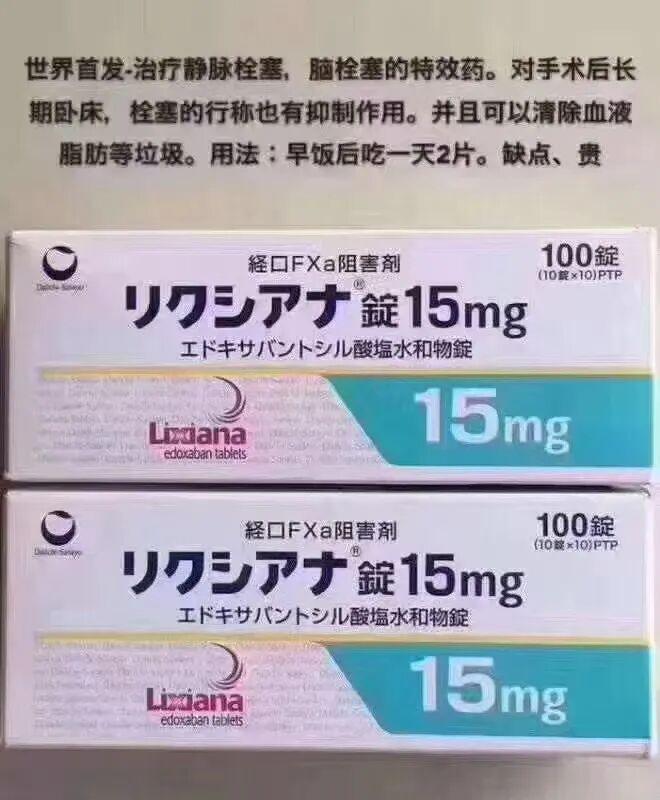
日本語原題:リクシアナ錠15mg

Published2025-05-24 11:00 Maker第一三共 FormTablet Content10 sections / 1 images
Ingredients / strength:
Each tablet contains 20.2mg edoxabant tosilicate hydrate (equivalent to 15mg as edoxaban).
English translation of the Japanese package insert is the main text; the Japanese original is shown alongside for verification. Use the language menu (top right) to read the page in another language. This site is for reference only — consult a doctor or pharmacist before use.
Section 1 · 01
English translation
Feature Description Edoxaban competitively and selectively inhibited human activated blood coagulation factor X (FXa) in vitro. The inhibitory activity of other coagulation-related factors such as thrombin against serine proteases was weak.
Section 2 · 02
English translation
Specifications (PTP) 100 tablets (10 tablets × 10).
Section 3 · 03
English translation
Characteristics Yellow, film-coated tablets.
Section 4 · 04
English translation
Ingredient Information Active ingredient: 20.2 mg edoxabant tosilicate hydrate per tablet (15 mg as edoxaban). Additives: D-mannitol, partially alpha-starch, cropovidone, hydroxypropyl cellulose, magnesium stearate, hypromellose, titanium dioxide, talc, macrogol 6000, yellow ferric oxide, carnauba barrow.
Section 5 · 05
English translation
Indications 1. Suppression of the onset of ischemic stroke and systemic embolism in patients with non-valvular atrial fibrillation 2. Treatment and recurrence suppression of venous thromboembolism (deep vein thrombosis and pulmonary thromboembolism) 3. Suppression of thromboembolism and embolism formation in patients with chronic thromboembolic pulmonary hypertension 4. Suppression of the onset of venous thromboembolism in patients undergoing lower limb orthopedic surgery as described below Total knee replacement, total hip replacement, hip fracture surgery.
Section 6 · 06
English translation
Dosage and Administration 1. Suppression of Ischemic Stroke and Systemic Embolism in Patients with Nonvalvular Atrial Fibrillation Typically, adults are given the following oral doses as edoxaban once daily. Body weight under 60kg: 30mg For body weight over 60kg: 60mg. Depending on renal function and combination medication, reduce to 30mg once daily. Additionally, for elderly patients at high risk of bleeding, the dose can be reduced to 15 mg once daily depending on age and patient condition. 2. Treatment and recurrence control of venous thromboembolism, and suppression of thromboembolism and embolism in patients with chronic thromboembolic pulmonary hypertension. Typically, adults are given the following oral doses as edoxaban once daily. Body weight under 60kg: 30mg For body weight over 60kg: 60mg. Depending on renal function and combination medication, reduce to 30mg once daily. 3. "Suppression of Venous Thromboembolism in Patients Undergoing Lower Limb Orthopedic Surgery" Typically, adults receive 30 mg orally once daily as edoxaban.
Section 7 · 07
English translation
Notes 〈Common Effects〉 1. Routine coagulation tests such as prothrombin time-to-international standard ratio (PT-INR) or activated partial thromboplastin-time (APTT) are not indicators for monitoring the efficacy of this drug, so clinical symptoms should be carefully observed. 2. Since side effects such as bleeding may occur, it is advisable to perform clinical tests such as blood counts (hemoglobin and platelet count) and fecal occult blood tests as needed. 3. If patients notice abnormal bleeding signs such as nosebleeds, subcutaneous bleeding, gum bleeding, hematuria, hemoptysis, vomiting blood, or bloody stools, instruct them to contact a doctor. 4. Provide sufficient medication guidance so that patients do not discontinue this medication at their own discretion. If a dose is missed, instruct patients not to take two doses at once, but to take one dose immediately and to wait at least 12 hours before the next dose. 5. When switching between this drug and other anticoagulants, please pay attention to the following points. (1) When switching from warfarin to this drug, discontinue warfarin administration, perform blood coagulation tests such as PT-INR, confirm that the drug is below the lower limit of the therapeutic range, and start administration of this drug as soon as possible. (2) When switching from unfractionated heparin to this drug, start administration of this drug 4±1 hours after discontinuing continuous infusion. (3) When switching from other anticoagulants (other than warfarin and unfractionated heparin) to this drug, start administration of this drug at the scheduled time for the next dose. The effects on prothrombin time (PT), APTT, or anti-FXa activity when switching to a single dose of this drug after 3 days of administration of rivaloxaban or apixaban in healthy adults were comparable to those on day 4 of repeated administration of this drug. Similarly, APTT when switching from dabigatran to this drug was comparable to that on day 3 of repeated dabigatran dosing. (4) When switching from this drug to warfarin, care should be taken to maintain the anticoagulant effect. Until PT-INR exceeds the lower limit of the therapeutic range, patients receiving 30 mg of this drug should receive 15 mg once daily with warfarin, and patients receiving 60 mg of this drug should receive warfarin once daily. Alternatively, after completing administration of this drug, continue administering warfarin together with non-oral anticoagulants (such as heparin) until PT-INR exceeds the lower limit of the therapeutic range. Note that PT-INR does not accurately reflect the anticoagulant effect of warfarin until 24 hours after completion of this drug, so PTINR must be measured just before the next dose of this drug. (5) When switching from this drug to an anticoagulant other than warfarin, discontinue administration of this drug and begin administration at the scheduled time for the next dose. 6. If surgery or invasive procedures are performed during administration of this drug, it is preferable to wait at least 24 hours since administration. If you cannot delay the start of surgery or invasive procedures, assess urgency and bleeding risk. Resumption of this drug should be done as soon as possible after confirming that the patient's clinical condition is stable and there is no bleeding after surgery or invasive procedures. Also, consider the use of alternative therapies (such as heparin) as needed. 7. If life-threatening bleeding or bleeding with difficult-to-stop hemostasis occurs in patients receiving this drug and the anticoagulant effect of this drug is required, be sure to refer to the electronic addendum of the neutralizing agent andexanet alpha (genetically modified). 〈Suppression of Venous Thromboembolism in Patients Undergoing Lower Limb Orthopedic Surgery〉 1. As a general rule, use should be limited to postoperative hospitalization. 2. The duration of administration should be determined considering the individual risk of venous thromboembolism and bleeding in each patient, and do not continue administration indiscriminately after the risk of venous thromboembolism has decreased. However, in domestic clinical trials, efficacy and safety of administration for 15 days or more in patients undergoing lower limb orthopedic surgery have not been examined.
Section 8 · 08
English translation
Side Effects 1. Bleeding Serious bleeding such as gastrointestinal bleeding (1.3%), intracranial hemorrhage (0.3%), intraocular hemorrhage (0.2%), wound bleeding (less than 0.1%), and retroperitoneal hemorrhage (frequency unknown) can occur in any tissue and organ, with fatal cases reported. If clinically problematic bleeding or worsening bleeding is observed, discontinue administration. 2. Acute kidney injury (frequency unknown) Acute renal injury may appear after administration of oral anticoagulants. Among acute kidney injuries following oral anticoagulant administration, hematuria is observed, and renal biopsy has reported numerous red blood cell columns in the renal tubules1),2). 3. Liver dysfunction (frequency unknown), jaundice (frequency unknown) Liver dysfunction accompanied by elevated AST and ALT levels, as well as jaundice, may occur. 4. Interstitial lung disease (frequency unknown) There may also be bloody sputum or alveolar hemorrhage. If cough, shortness of breath, difficulty breathing, fever, or abnormal lung sounds are observed, promptly perform chest X-ray, chest CT, serum markers, and other tests. If interstitial lung disease is suspected, discontinue administration and take appropriate measures such as administering corticosteroids. 5. Thrombocytopenia (frequency unknown) 6. Blood Anemia, increased platelet count, eosinophils. 7. Tendency to bleed Nosebleeds, hematuria (such as positive blood in urine), subcutaneous bleeding, bruises, wound bleeding, excessive menstruation, and intra-articular hematoma. 8. Liver Liver dysfunction is abnormal, with increased γ-GTP, ALT, bilirubin, AST, ALP, and LDH. 9. Neuropsychiatric System Headache, floating dizziness. 10. Digestive System Diarrhea, nausea, abdominal pain. 11. Allergies Rash, itching, angioedema, urticaria. 12. Others Edema, increased uric acid, elevated triglycerides, fever.
Section 9 · 09
English translation
taboo 1. "Common Efficacy" (1) Patients with a history of hypersensitivity to any component of this drug (2) Patients with bleeding (intracranial hemorrhage, retroperitoneal hemorrhage, or bleeding in other vital organs, etc.) [May promote bleeding. ] (3) Patients with acute bacterial endocarditis [thromboembolism associated with thrombodissection] There is a risk of presenting symptoms such as the such. ] 2. "Suppression of the onset of ischemic stroke and systemic embolism in patients with non-valvular atrial fibrillation; treatment and recurrence suppression of venous thromboembolism; suppression of thromboembolism and embolism formation in patients with chronic thromboembolic pulmonary hypertension." (1) Patients with renal failure (creatinine clearance less than 15 mL/min) (2) Patients with liver disease accompanied by coagulation disorders 3. "Suppression of Venous Thromboembolism in Patients Undergoing Lower Limb Orthopedic Surgery" Patients with severe renal impairment (creatinine clearance below 30 mL/min)
Section 10 · 10
English translation
Warning 1. Bleeding may occur after administration of this drug, and in cases of severe bleeding, there is a risk of death. When using this drug, carefully consider the risk of bleeding and determine the suitability of administration. Since there is no established indicator to accurately assess bleeding risk from this drug, during administration of this drug, it is important to carefully observe not only blood clotting test results but also signs such as bleeding and anemia. If these signs are observed, take appropriate action immediately. 2. When combined with spinal or epidural anesthesia or lumbar puncture, hematoma may form at the puncture site, leading to paralysis due to nerve compression. When used together, pay close attention to signs and symptoms of neurological disorders, and if abnormalities are detected, take appropriate treatment immediately.

Source images

1 images

Need help sourcing Japanese medicines or OEM production?

💬