Digoxin
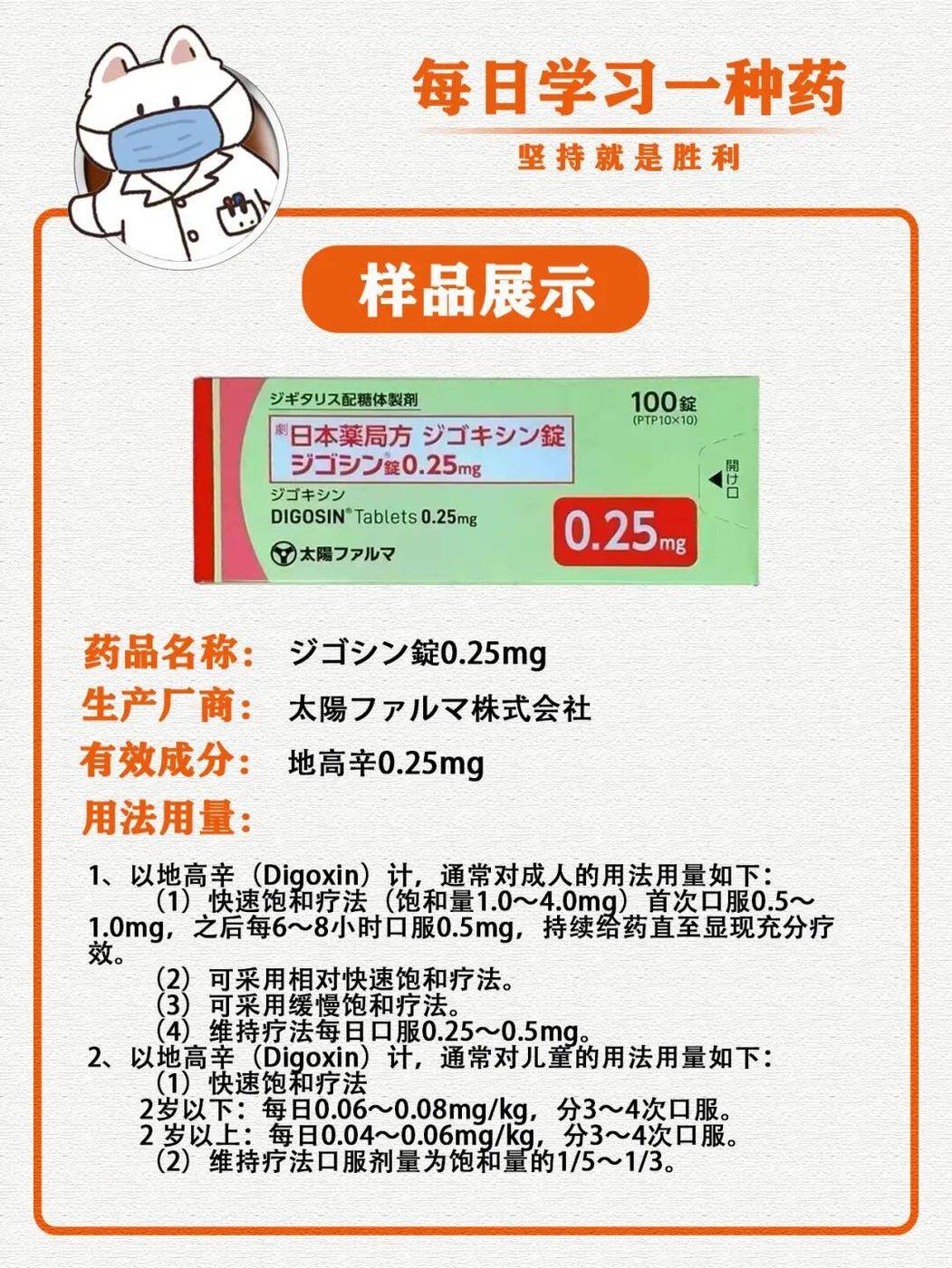
日本語原題:ジゴシン錠0.25mg
Source images
2 imagesThe artwork keeps its original Japanese/Chinese lettering. Open “Text in this image” under a picture to read what it says in your language (machine-read, may contain errors).
Text in this image machine-read · may contain errors
Digital Formulation (PTP10X10) Japanese Pharmacopoeia Digoxin Tablets Shicosin Tablets 0.25 digoxin Solar Pharma Drug Name: Sha Ding 0.25mg Manufacturer: Taiyo Pharma Co., Ltd. Active ingredients: digoxin 0.25mg Dosage and administration: 1. Measured by digoxin, the usual dosage and administration for adults are as follows: (1) Rapid saturation therapy (saturation dose 1.0~4.0mg): first oral dose 0.5~ 1.0mg, then take 0.5mg orally every 6~8 hours, continuing administration until full treatment is observed. Relatively rapid saturation therapy can be used. Slow saturation therapy can be used. (4) Maintenance therapy: daily oral administration of 0.25~0.5mg. 2. Measured by digoxin, the usual dosage and administration for children are as follows: (1) Rapid Saturation Therapy Under 2 years old: 0.06~0.08mg/kg daily, divided orally into 3~4 doses. Ages 2 and above: 0.04~0.06mg/kg daily, divided orally into 3~4 doses. (2) Maintenance therapy: oral dose is 1/5~1/3 of saturated dose.
ジギタリス配物体製剤 (PTP10X10) 第日本薬局方ジゴキシン錠 シコシン錠 0.25 叫 ジゴキシン 太陽ファルマ 药品名称:沙锭0.25mg 生产厂商: 太陽ファルマ株式会社 有效成分: 地高辛0.25mg 用法用量: 1、以地高辛(Digoxin)计,通常对成人的用法用量如下: (1)快速饱和疗法(饱和量1.0~4.0mg)首次口服0.5~ 1.0mg,之后每6~8小时口服0.5mg,持续给药直至显现充分疗 可采用相对快速饱和疗法。 可采用缓慢饱和疗法。 (4)维持疗法每日口服0.25~0.5mg。 2、以地高辛(Digoxin)计,通常对儿童的用法用量如下: (1)快速饱和疗法 2岁以下:每日0.06~0.08mg/kg,分3~4次口服。 2岁以上:每日0.04~0.06mg/kg,分3~4次口服。 (2)维持疗法口服剂量为饱和量的1/5~1/3。
Digital Formulation (PTP10X10) Japanese Pharmacopoeia Digoxin Tablets Shicosin Tablets 0.25 digoxin Solar Pharma Drug Name: Sha Ding 0.25mg Manufacturer: Taiyo Pharma Co., Ltd. Active ingred…
Text in this image machine-read · may contain errors
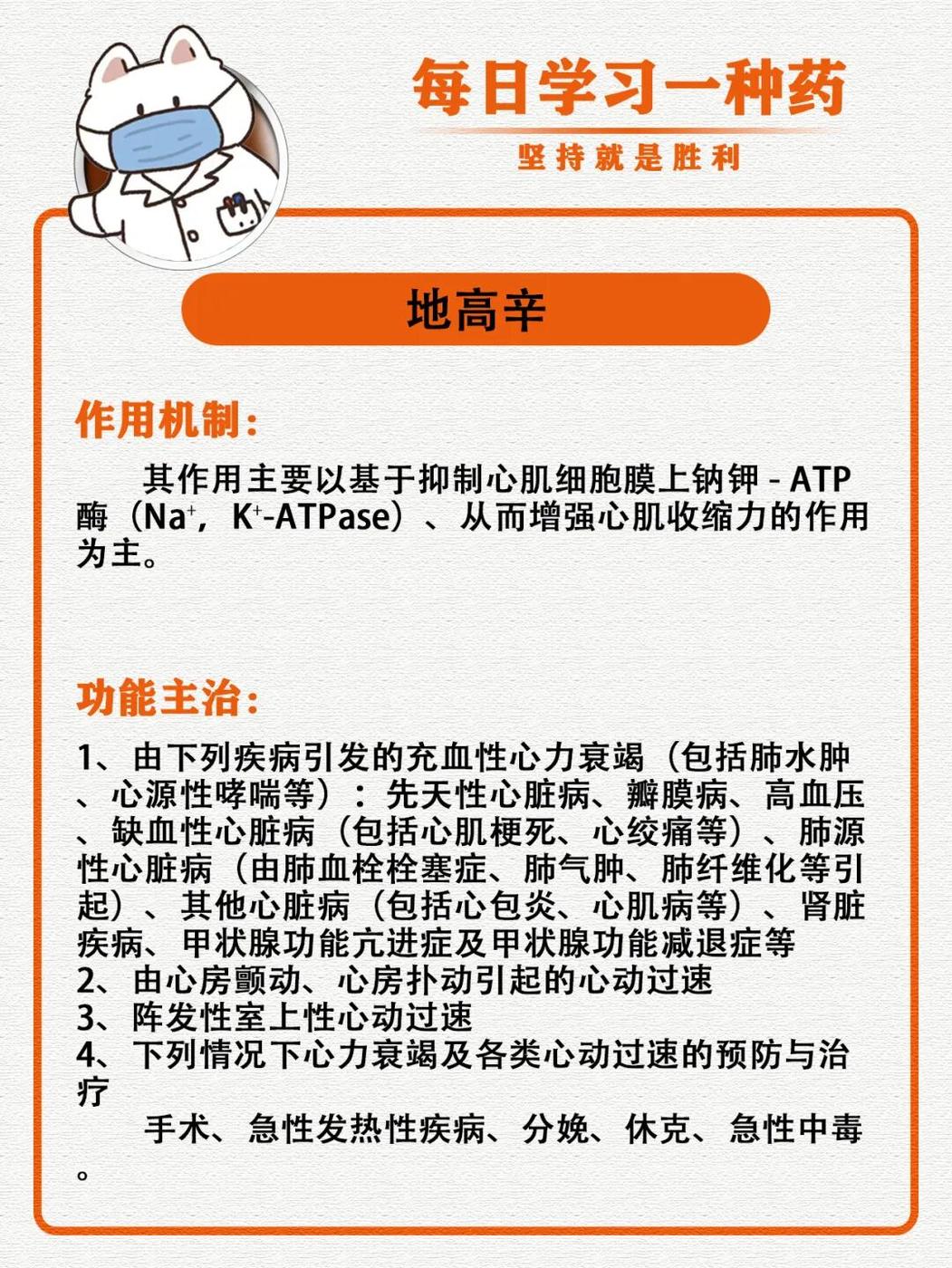
Mechanism of action: Its main action is to inhibit sodium-potassium ATP on the membranes of myocardial cells enzyme (Nat, K+-ATPase), thereby enhancing myocardial contractility to be the master. Functions and indications: 1. Congestive heart failure (including pulmonary edema) caused by the following diseases cardiogenic asthma, etc.): congenital heart disease, valvular disease, hypertension Ischemic heart disease (including myocardial infarction, angina, etc.), pulmonary origin Sexual heart disease (caused by pulmonary thromboembolism, emphysema, pulmonary fibrosis, etc Other heart diseases (including pericarditis, cardiomyopathy, etc.), and kidneys Diseases, hyperthyroidism, and hypothyroidism, among others 2. Tachycardia caused by atrial fibrillation or atrial flutter Paroxysmal supraventricular tachycardia Prevention and treatment of heart failure and various tachycardia under the following conditions Surgery, acute febrile illness, childbirth, shock, acute poisoning
作用机制: 其作用主要以基于抑制心肌细胞膜上钠钾-ATP 酶(Nat,K+-ATPase)、从而增强心肌收缩力的作用 为主。 功能主治: 1、由下列疾病引发的充血性心力衰竭(包括肺水肿 心源性哮喘等):先天性心脏病、瓣膜病、高血压 缺血性心脏病(包括心肌梗死、心绞痛等)、肺源 性心脏病(由肺血栓栓塞症、肺气肿、肺纤维化等引 起)、其他心脏病(包括心包炎、心肌病等)、肾脏 疾病、甲状腺功能亢进症及甲状腺功能减退症等 2、由心房颤动、心房扑动引起的心动过速 阵发性室上性心动过速 下列情况下心力衰竭及各类心动过速的预防与治 手术、急性发热性疾病、分娩、休克、急性中毒
Mechanism of action: Its main action is to inhibit sodium-potassium ATP on the membranes of myocardial cells enzyme (Nat, K+-ATPase), thereby enhancing myocardial contractility to be the mas…