Digestive · DIGESTIVE

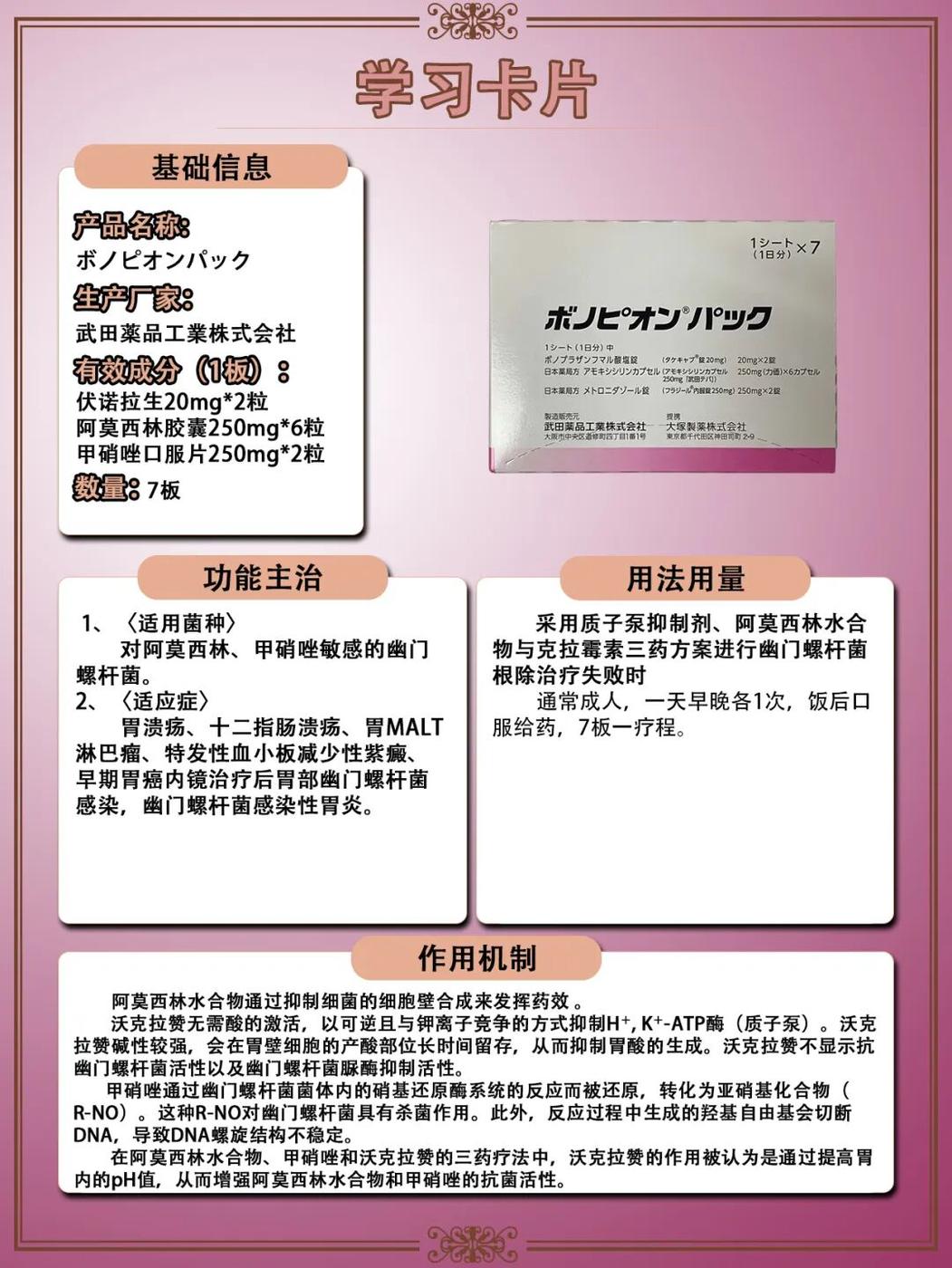
Vonopazan + Amoxicillin + metronidazole

日本語原題:ボノピオンパック

Published2026-07-28 13:57 FormTablet Content9 sections / 1 images
Ingredients / strength:
Each tablet contains 26.72mg of Bonoprazan fumarate (20mg as Bonoprazan).
English translation of the Japanese package insert is the main text; the Japanese original is shown alongside for verification. Use the language menu (top right) to read the page in another language. This site is for reference only — consult a doctor or pharmacist before use.
Section 1 · 01
English translation
Feature Description Amoxicillin hydrate exerts its effects by inhibiting bacterial cell wall synthesis14). Bonoprazane does not require acid activation and inhibits H+ and K+-ATPases in a reversible, potassium-ion-competitive manner. Bonoprazan is highly basic and remains for a long time at acid-producing sites in gastric parietal cells, suppressing gastric acid production. Bonoprazan does not exhibit anti-Helicobacter pylori activity or Helicobacter pyloriurease inhibitory activity15). Metronidazole is reduced by a nitroreductase system within Helicobacter pylori bacteria, converting it into nitroso compounds (R-NO). This R-NO exhibits bactericidal effects against Helicobacter pylori. Additionally, hydroxyl radicals generated during the reaction cleave DNA, causing destabilization of the DNA helix structure. The role of bonoprazan in triple therapy with amoxicillin hydrate and metronidazole is thought to be to enhance the antibacterial activity of amoxicillin hydrate and metronidazole by raising gastric pH.
Section 2 · 02
English translation
Specifications 7 sheets with PTP (1 sheet ×7, with desiccant).
Section 3 · 03
English translation
Characteristics 1. 〈Takecab Tablets 20mg〉 A film-coated lock with a faint red double-sided split line. 2. Amoxicillin Capsules 250mg Both the head and body are white hard capsules. 3. Fluzyl Oral Tablets 250mg White round sugar-coated tablets.
Section 4 · 04
English translation
Ingredient Information 1. Per sheet (1 day) (1) Takecab Tablets 20mg, 2 tablets (2) Amoxicillin Capsules 250mg 6 capsules (3) Fluzyl oral tablets 250mg, 2 tablets The compositions of formulations 2 and 3 are as follows. (1) 〈Take Cab Tablets 20mg〉 (1) Active ingredient: 26.72mg of Bonoprazan fumarate per tablet (20mg as Bonoprazan). (2) Additives: D-mannitol, crystalline cellulose, croscarmellose sodium, hydroxypropyl cellulose, fumaric acid, magnesium stearate, hypromellose, macrogol 6000, titanium oxide, ferric trioxide. (2) Amoxicillin Capsules 250mg (1) Active ingredient: 250mg of Japanese amoxicillin hydrate per capsule (potency). (2) Additives: magnesium stearate, methylcellulose, corn starch, gelatin, sodium lauryl sulfate. (3) Oral Frazil Tablets 250mg (1) Active ingredient: 1 capsule of China-Japan Domestique Metronidazole 250mg. (2) Additives: Corn starch, glycerin, methylcellulose, amethyl, talc, magnesium stearate, white sugar, sodium starch, gum arabic powder, gelatin, precipitated calcium carbonate, sodium benzoate, carnauba brow.
Section 5 · 05
English translation
Indications 1. Suitable Strain Species Helicobacter pylori sensitive to amoxicillin and metronidazole. 2. Indications After endoscopic treatment for gastric ulcers, duodenal ulcers, gastric MALT lymphoma, idiopathic thrombocytopenic purpura, and early gastric cancer, Helicobacter pylori infection in the stomach, and Helicobacter pylori gastritis.
Section 6 · 06
English translation
Dosage and Administration When Helicobacter pylori eradication treatment with triple administration of proton pump inhibitor, amoxicillin hydrate, and clarithromycin fails Typically, adults receive three oral doses simultaneously: 20 mg of vonoplazan per dose, 750 mg of amoxicillin hydrate (potency) per dose, and 250 mg of metronidazole twice daily for 7 days.
Section 7 · 07
English translation
Notes Do not use any individual formulation packaged in this product alone or for any purpose other than the efficacy or efficacy of this product. Also, take simultaneously as prescribed and dosage. 1. Amoxicillin Hydrate (1) There is no definitive way to predict the occurrence of shock, anaphylaxis, acute coronary syndrome due to allergic reactions, or drug-induced gastroenteritis syndrome, but a thorough medical interview should be conducted beforehand regarding the history of the relevant event. Also, always confirm any history of allergic reactions to antibiotics. (2) Severe kidney damage such as acute kidney injury may occur, so regular examinations and thorough observation are necessary. (3) Granulocytopenia and thrombocytopenia may occur, so regular tests and thorough observation are essential. 2. Metronidazole (1) Since leukopenia and neutropenia may occur, regularly perform blood tests and closely monitor the patient's condition. (2) Since liver dysfunction may occur, regularly perform liver function tests and closely monitor the patient's condition.
Section 8 · 08
English translation
Side Effects 1. Bonoplastane Fumarate (1) Shock, anaphylaxis (both unknown frequency) (2) Pancytopenia, agranulocytosis, leukopenia, thrombocytopenia (all frequency unknown) (3) Liver dysfunction (frequency unknown) (4) Toxic epidermal necrolysis (TEN), Stevens-Johnson syndrome, erythema multiforme (all unknown frequency) 2. Amoxicillin hydrate (1) Shock and anaphylaxis (both less than 0.1%) If discomfort, abnormal sensations in the mouth, dizziness, urge to defecate, tinnitus, sweating, wheezing, difficulty breathing, angioedema, or systemic flushing or urticaria are observed, discontinue administration and take appropriate measures. (2) Acute coronary syndrome associated with allergic reactions (frequency unknown) (3) Drug-induced gastroenteritis syndrome (frequency unknown) The main symptoms are recurrent vomiting within a few hours of administration, and symptoms such as diarrhea, drowsiness, pallor, hypotension, abdominal pain, and neutrophil increase may occur, similar to food-protein-induced gastroenteritis. It has been mainly reported in children. (4) Toxic epidermal necrolysis (TEN), Stevens-Johnson syndrome (all less than 0.1% (Note 1)), erythema multiforme, acute generalized exanthematous pustulosis, erythroderma (exfoliative dermatitis) (all frequency unknown) If abnormalities such as fever, headache, joint pain, erythema, blisters, pustules on skin or mucous membranes, or skin tension, burning, or pain are observed, discontinue administration and take appropriate measures. (5) Severe kidney injury such as acute kidney injury (less than 0.1%) (6) Granulocytopenia (less than 0.1%), thrombocytopenia (frequency unknown) (7) Severe colitis with bloody stools such as pseudomembranous colitis (less than 0.1%) If abdominal pain or frequent diarrhea occurs, immediately discontinue administration and take appropriate measures. (8) Liver dysfunction and jaundice (both less than 0.1%) Liver dysfunction accompanied by elevated AST and ALT levels, as well as jaundice, may occur. (9) Interstitial pneumonia, eosinophilic pneumonia (both of unknown frequency) If cough, difficulty breathing, fever, or similar symptoms are observed, promptly perform chest X-ray, chest CT, or other examinations. If interstitial pneumonia or eosinophilic pneumonia is suspected, discontinue administration and take appropriate measures such as administering corticosteroids. (10) Aseptic meningitis (frequency unknown) Aseptic meningitis accompanied by neck stiffness, fever, headache, nausea, vomiting, or confusion may occur. 3. Metronidazole (1) Peripheral neuropathy (frequency unknown) If numbness or abnormal sensations in the limbs are observed, discontinue administration and take appropriate measures. (2) Central nervous system disorders (frequency unknown) Encephalopathy, convulsions, confusion, hallucinations, cerebellar ataxia, and similar symptoms may occur. If early symptoms such as staggering, gait disturbances, consciousness impairment, speech disorders, or numbness of the limbs appear, and metronidazole encephalopathy is suspected, administration of metronidazole should be discontinued. (3) Aseptic meningitis (frequency unknown) Aseptic meningitis accompanied by neck stiffness, fever, headache, nausea, vomiting, or confusion may occur. (4) Toxic epidermal necrolysis (TEN), Stevens-Johnson syndrome (both frequency unknown) (5) Acute pancreatitis (frequency unknown) If abnormalities such as abdominal pain, back pain, nausea or vomiting, or elevated serum amylase levels are observed, discontinue administration and take appropriate measures. (6) Leukopenia and neutropenia (both frequency unknown) (7) Hemorrhagic Colitis (frequency unknown) If abdominal pain, bloody stools, or frequent diarrhea occur, discontinue administration immediately and provide appropriate treatment. (8) Liver dysfunction (frequency unknown) (9) QT prolongation, ventricular tachycardia (including Torsade de pointes) (both frequency unknown) 4. Other side effects (1) Helicobacter pylori Infection in Gastric or Duodenal Ulcers (1) Digestive system: diarrhea, abdominal discomfort, abdominal bloating. (2) Liver: Elevated AST and ALT. (2) Bonoplatan fumarate (1) Digestive system: constipation, diarrhea, abdominal bloating, nausea. (2) Hypersensitivity: rash. (3) Liver: Elevated AST, ALT, AL-P, LDH, and γ-GTP. (4) Others: edema, eosinophils. (3) Amoxicillin hydrate (1) Hypersensitivity: fever, rash, urticaria, itching. (2) Blood: eosinophil increase, anemia. (3) Liver: Elevated AST and ALT. (4) Digestive system: diarrhea, nausea, loss of appetite, black-haired tongue. (5) Bacterial replacement syndrome: stomatitis, colitis (such as Candida and insensitive Klebsiella). (6) Vitamin deficiency: symptoms of vitamin K deficiency (hypoprothrombinemia, bleeding tendencies, etc.), vitamin B group deficiency symptoms (glossitis, stomatitis, loss of appetite, neuritis, etc.). (7) Others: In syphilis patients: Yarlish-Herksheimer reaction (fever, general fatigue, headache, and worsening of lesions). (4) Metronidazole 〈Trichomoniasis (infection caused by vaginal trichomoniasis), anaerobic bacterial infections, infectious enteritis, bacterial vaginosis, amoebic dysentery, flagellated flagellate infections〉 (1) Hypersensitivity: rash. (2) Digestive system: tongue coating, loss of appetite, nausea, stomach discomfort, diarrhea, abdominal pain, taste disturbances. (3) Liver: increased AST, increased ALT, increased total bilirubin, increased AL-P, increased LDH, elevated γ-GTP. (4) Genitals: Appearance of Candida albicans. (5) Others: dark red urine, fever. (5) Helicobacter pylori Infection (1) Hypersensitivity: rash, itching. (2) Blood: increased basophils. (3) Digestive system: diarrhea, heartburn, nausea, upper abdominal pain, taste disturbances, oral aphthalmosis, glossitis, bloating, black stools. (4) Neuropsychiatric system: depression, headaches, floating dizziness, feelings of instability. (5) Others: Eye strain, fatigue, numbness.
Section 9 · 09
English translation
taboo 1. Patients with a history of hypersensitivity to any component of any formulation packaged in this product 2. Patients receiving atazanavir sulfate or rilpivirin hydrochloride 3. Patients with infectious mononucleosis [There are reports of a high incidence of erythematous papules with amoxicillin hydrate. ] 4. Patients with severe kidney impairment 5. Patients with organic diseases of the brain or spinal cord (excluding patients with brain abscess) [metronidazole may cause central nervous system symptoms. ] 6. Women within 3 months of pregnancy (excluding diseases where the benefits outweigh the risks)

Source images

1 images

Need help sourcing Japanese medicines or OEM production?

💬