Digestive · DIGESTIVE

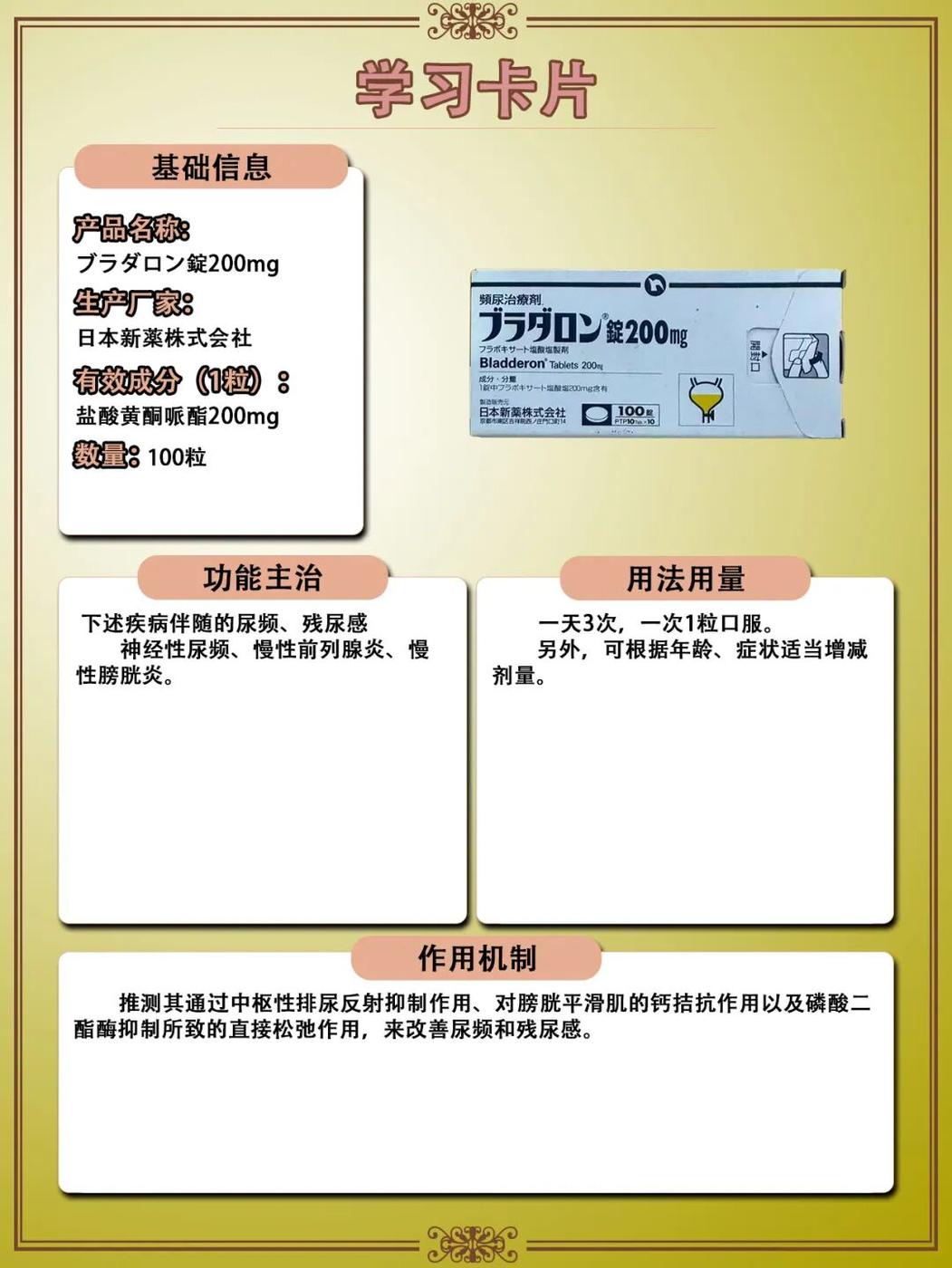
Flavoxate Hydrochloride

日本語原題:ブラダロン錠200mg

Published2026-08-02 10:20 FormTablet Content8 sections / 1 images
Ingredients / strength:
1 tablet of Chunichi Bureau Fluboxate Hydrochloride 200mg.
English translation of the Japanese package insert is the main text; the Japanese original is shown alongside for verification. Use the language menu (top right) to read the page in another language. This site is for reference only — consult a doctor or pharmacist before use.
Section 1 · 01
English translation
Feature Description It is presumed to improve frequent urination and the sensation of residual urination through central inhibition of the voiding reflex, calcium antagonism on bladder smooth muscle, and direct relaxation through phosphodiesterase inhibition.
Section 2 · 02
English translation
100 tablets [10 tablets (PTP packaging)×10].
Section 3 · 03
English translation
Characteristics Pale yellow, film-coated tablets.
Section 4 · 04
English translation
Ingredient Information Active ingredient: 1 tablet Chunichi Bureau Fluboxate Hydrochloride 200mg. Additives: corn starch, carmelose, polyvinyl alcohol (partial saponide), magnesium stearate, hypromellose, propylene glycol, carnauba bau, yellow trioxide.
Section 5 · 05
English translation
Indications Frequent urination and a feeling of residual urine associated with the following conditions Nervous frequent urination, chronic prostatitis, chronic cystitis.
Section 6 · 06
English translation
Dosage and Administration Typically, adults take one tablet per dose, three times a day orally. Adjust appropriately according to age and symptoms.
Section 7 · 07
English translation
Side Effects 1. Shock, anaphylaxis (both with unknown frequency) If abnormalities such as urticaria, cold sweats, difficulty breathing, laryngeal edema, or low blood pressure are observed, immediately discontinue administration and provide appropriate treatment. 2. Liver dysfunction and jaundice (both of unknown frequency) Liver dysfunction and jaundice accompanied by significant increases in AST, ALT, γ-GTP, Al-P, and bilirubin may occur; therefore, closely monitor and discontinue administration and take appropriate measures if abnormalities such as general fatigue, loss of appetite, fever, itching, or jaundice are observed. 3. Other side effects (1) Digestive system: stomach discomfort, loss of appetite, nausea, dry mouth, diarrhea, constipation, vomiting, stomach pain, abdominal pain, heartburn. (2) Hypersensitivity: Symptoms such as rash and itching. (3) Nervous system: drowsiness, insomnia, headache, dizziness, dizziness, dizziness, and numbness. (4) Eyes: Eye irritation, increased intraocular pressure, accommodation disorders. (5) Blood: eosinophil increase, white blood cell count. (6) Urinary system: difficulty urinating, urinary retention. (7) Others: lower abdominal bloating, facial heat, palpitations, chest discomfort, heat, throat discomfort, hoarseness.
Section 8 · 08
English translation
taboo 1. Patients with obstruction of the pylorus, duodenum, and intestines [weak parasympathetic suppression suppresses intestinal motility. ] 2. Patients with severe passage disorders in the lower urinary tract [Because it has a weak parasympathetic depressive effect, it may relax the detrusor muscles and contract the bladder sphincter.] ]

Source images

1 images

Need help sourcing Japanese medicines or OEM production?

💬