Cardiovascular · CARDIOVASCULAR

Bisoprolol Fumarate

日本語原題:メインテート錠2.5/5mg

Published2026-09-03 10:16 FormTablet Content10 sections / 1 images
Ingredients / strength:
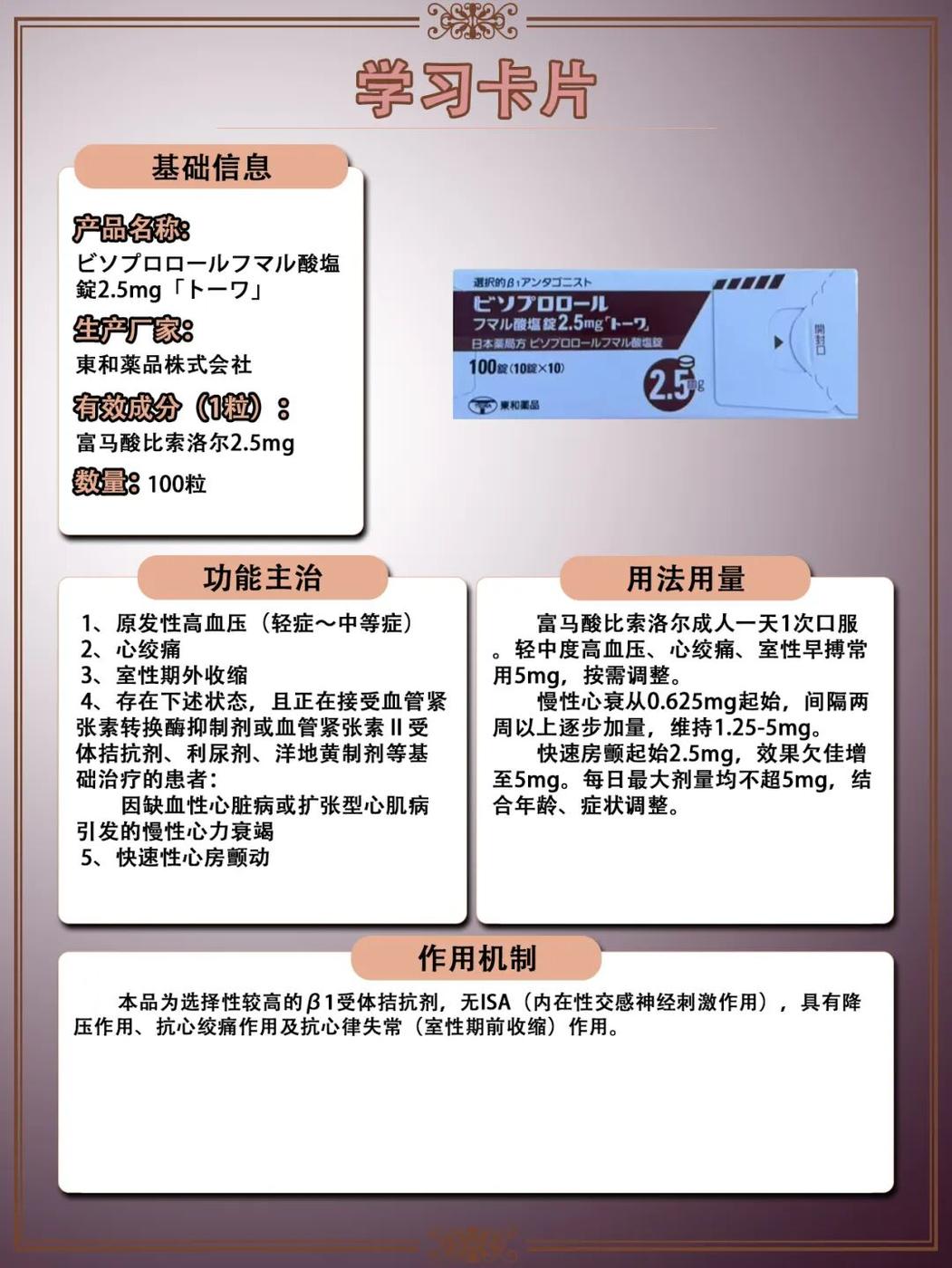
Nippon Bureau Bisoprolol Fumarate 2.5mg.
English translation of the Japanese package insert is the main text; the Japanese original is shown alongside for verification. Use the language menu (top right) to read the page in another language. This site is for reference only — consult a doctor or pharmacist before use.
Section 1 · 01
English translation
Feature Description It is a highly selective β1 antagonist with no intrinsic sympathetic stimulation (ISA), and exhibits antihypertensive, antianginal, and antiarrhythmic (ventricular premature contractions) effects.
Section 2 · 02
English translation
Specifications 100 tablets [10 tablets×10: PTP, with desiccant].
Section 3 · 03
English translation
Characteristics A white nug with a split line.
Section 4 · 04
English translation
Ingredient Information Active ingredient per tablet: Nippon Bureau Bisoprolol Fumarate 2.5mg. Additives: D-mannitol, magnesium stearate.
Section 5 · 05
English translation
Indications 1. Essential Hypertension (Mild~Moderate) 2. Angina pectoris 3. Ventricular premature contractions 4. Patients receiving basic treatment such as angiotensin-converting enzyme inhibitors, angiotensin receptor antagonists, diuretics, or digitalis preparations in the following conditions: Chronic heart failure based on ischemic heart disease or dilated cardiomyopathy 5. Tachycardial Atrial Fibrillation
Section 6 · 06
English translation
Dosage and Administration 1. Essential hypertension (mild~moderate), angina, ventricular premature contractions. Typically, adults receive 5 mg orally once daily as bisoprolol fumarate. Adjust appropriately according to age and symptoms. 2. Chronic heart failure based on ischemic heart disease or dilated cardiomyopathy Typically, adults start with an oral dose of 0.625 mg once daily as bisoprolol fumarate. Oral administration at a dose of 0.625 mg once daily for more than two weeks, increasing to 1.25 mg once daily if tolerated. If tolerability is maintained, the dose is gradually increased at intervals of four weeks or more while monitoring tolerance, and if intolerable, weight reduction is performed. Dosage adjustments should always be done stepwise at doses of 0.625, 1.25, 2.5, 3.75, or 5 mg, and in all cases, oral administration should be administered once daily. Typically, the maintenance dose is 1.25~5 mg orally once daily. Depending on age and symptoms, the starting dose may be further reduced, and the increment range may be even smaller. Additionally, the maintenance dose may be adjusted appropriately depending on the patient's response to this drug, but the maximum dose should not exceed 5 mg once daily. 3. "Tachycardial Atrial Fibrillation" Typically, adults start with 2.5 mg orally once daily as bisoprolol fumarate, and if efficacy is insufficient, increase to 5 mg once daily. Adjustments may be made according to age and symptoms, but the maximum dose should not exceed 5 mg once daily.
Section 7 · 07
English translation
Notes 1. "Common Efficacy" (1) If the administration is long-term, perform regular cardiac function tests (pulse, blood pressure, ECG, X-rays, etc.). If symptoms of bradycardia or hypotension appear, reduce the dose or discontinue administration. Also, use atropine as needed. Also, pay attention to liver function, kidney function, blood profile, and other factors. (2) There have been reports of symptoms worsening or myocardial infarction in angina patients who suddenly stop administration while using similar compounds (propranolol hydrochloride). If discontinuation is necessary, gradually reduce the dose and monitor carefully. Also, patients should be careful not to stop taking medication without a doctor's guidance. Even when administered for non-angina cases, such as arrhythmias, the same caution should be exercised, especially in elderly patients. (3) It is desirable not to administer for 48 hours before surgery. (4) Dizziness and unsteadiness may occur, so patients receiving this drug (especially in the early stages) should exercise caution when operating dangerous machinery such as driving a car. 2. "Chronic Heart Failure" (1) When administering to patients with chronic heart failure, it is preferable to administer this drug during hospitalization during the initial administration and dose escalation. (2) Administration of this drug to patients with severe chronic heart failure requires particularly careful management; administer during initial administration and dose escalation during hospitalization. (3) During the initial administration and at dose escalation, worsening of heart failure, edema, weight gain, dizziness, hypotension, bradycardia, blood glucose fluctuations, and renal function deterioration are likely. Therefore, closely monitor and confirm tolerability. (4) To prevent worsening of heart failure and fluid retention (edema, weight gain, etc.) during the initial or increased dose, ensure adequate treatment of fluid retention before administration. If worsening heart failure or fluid retention (edema, weight gain, etc.) is observed and increasing diuretic dosage does not improve the condition, reduce or discontinue this medication. If symptoms such as hypotension or dizziness are observed and do not improve with dose reduction with angiotensin-converting enzyme inhibitors or diuretics, reduce the dose of this drug. If you develop a severe bradycardia, reduce the dose of this drug. Also, do not increase the dose of this drug until these symptoms stabilize. (5) If administration of this drug is suddenly discontinued, there is a risk of transient worsening of heart failure; if discontinuation, do not stop abruptly; in principle, gradually reduce the dose and discontinue the treatment.
Section 8 · 08
English translation
Side Effects 1. Heart failure (in cases of hypertension, frequency unknown; in chronic heart failure: 7.0%), complete atrioventricular block, high bradycardia, sinus failure syndrome (in cases of hypertension, etc.: frequency unknown; in chronic heart failure: frequency unknown) 2. Other side effects (1) Essential hypertension, angina, ventricular premature contractions, tachycardial atrial fibrillation (1) Cardiovascular system: bradycardia, increased cardiothoracic ratio, hypotension, palpitations, ventricular premature contractions, atrioventricular block, atrial fibrillation, chest pain. (2) Nervous system: headache, heaviness in the head, dizziness, dizziness, lightheadedness, drowsiness, insomnia, nightmares. (3) Digestive system: nausea, vomiting, stomach discomfort, abdominal discomfort, loss of appetite, diarrhea. (4) Liver: Increased AST, ALT, bilirubin, LDH, ALP, γ-GTP, liver enlargement. (5) Kidneys and urinary system: elevated uric acid, creatinine, BUN, urine glucose, frequent urination. (6) Respiratory system: difficulty breathing, bronchospasm. (7) Hypersensitivity: rash, itchy skin. (8) Eyes: Foggy vision, reduced tear secretion. (9) Others: fatigue, edema, weakness, malaise, fatigue, cold limbs, chills, numbness, increased CK, worsening diabetes, elevated serum lipids. (2) "Chronic Heart Failure" (1) Cardiovascular system: bradycardia, increased cardiothoracic ratio, atrioventricular block, hypotension, palpitations, chest pain, atrial fibrillation, ventricular premature contractions. (2) Psychiatric and nervous system: dizziness (16.0%), lightheadedness, headache/heaviness in the head, dizziness, drowsiness, insomnia, nightmares. (3) Digestive system; Nausea, abdominal discomfort, loss of appetite, vomiting, stomach discomfort, diarrhea. (4) Liver: Elevated AST and ALT, hepatomegaly, elevated bilirubin, LDH, ALP, and γ-GTP. (5) Kidneys and urinary system: increased uric acid, creatinine levels, increased BUN, urine glucose, frequent urination. (6) Respiratory system: Difficulty breathing (11.0%), bronchospasm. (7) Hypersensitivity: rash, itchy skin. (8) Eyes: Foggy vision, reduced tear secretion. (9) Others: fatigue (10.0%), edema (11.0%), elevated serum lipids, weakness, malaise, fatigue, cold limbs, numbness, increased CK, worsening diabetes, chills.
Section 9 · 09
English translation
taboo 1. Patients with severe bradycardia (pronounced sinus bradycardia), atrioventricular block (grade II or III), sinoatrial block, or sinus insufficiency syndrome [may worsen symptoms]. ] 2. Patients with diabetic ketoacidosis or metabolic acidosis [may enhance the suppression of cardiac contractility based on acidosis. ] 3. Patients with cardiogenic shock [cardiac function may be suppressed and symptoms may worsen. ] 4. Patients with right heart failure due to pulmonary hypertension [cardiac function may be suppressed and symptoms may worsen. ] 5. Patients with heart failure who require intravenous administration of cardiac or vasodilators [due to the suppressive effect of cardiac contractility, there is a risk of worsening heart failure. ] 6. Patients with non-compensated heart failure [Due to the effect of suppressing cardiac contractility, there is a risk of worsening heart failure. ] 7. Patients with severe peripheral circulatory disorders (such as gangrene) [May suppress dilation of peripheral blood vessels and worsen symptoms. ] 8. Patients with untreated pheochromocytoma or paraganglioma 9. Patients with a history of hypersensitivity to any component of this drug
Section 10 · 10
English translation
Warning 〈Chronic Heart Failure〉 Use under a physician with sufficient experience treating chronic heart failure. Be cautious of symptoms worsening at the initial stage of administration and during dose increases, and adjust the dose carefully.

Source images

1 images

Need help sourcing Japanese medicines or OEM production?

💬