Spironolactone
日本語原題:アルダクトンA錠25mg
Source images
1 imagesThe artwork keeps its original Japanese/Chinese lettering. Open “Text in this image” under a picture to read what it says in your language (machine-read, may contain errors).
Text in this image machine-read · may contain errors
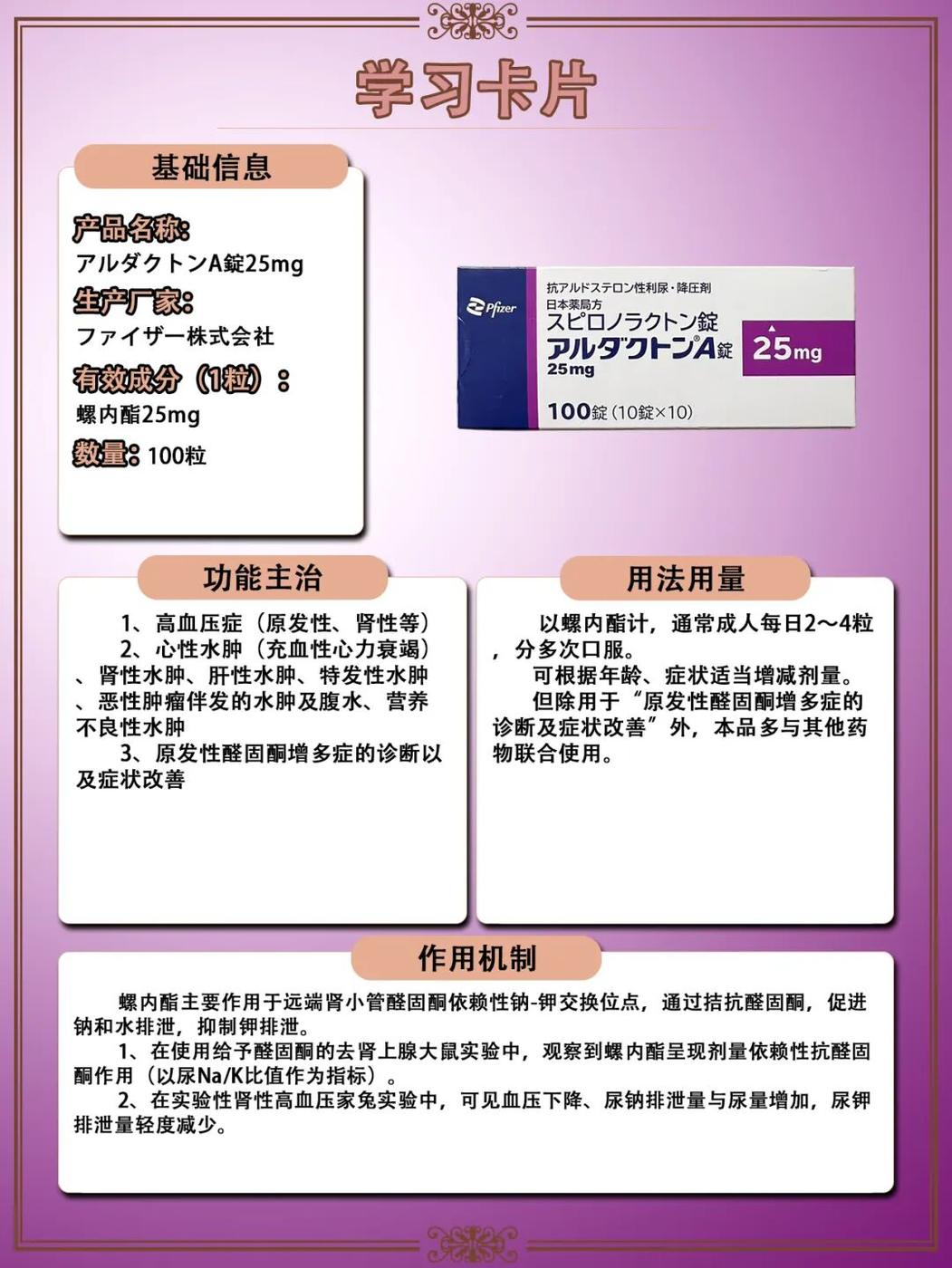
Basic information Product Name: Aldaktone A tablets 25mg Resist Erxia and also have oral diuretics and antihypertensive agents Manufacturer: Spironolactone tablets Pfizer Inc 25mg Aldariton Lock Active ingredient (1 capsule): Spironolactone 25mg 100 ingots (10 ingots ×10) Quantity: 100 capsules Functions and indications Usage and dosage 1. Hypertension (primary, nephronic, etc.) Calculated as spironolactone, adults usually take 2~4 capsules daily 2. Cardiac edema (congestive heart failure) , divided into multiple oral doses. Renal edema, hepatic edema, idiopathic edema Dosage can be adjusted appropriately according to age and symptoms. However, except for cases used for "primary aldosteronism." Edema and ascites associated with malignant tumors, as well as nutritional issues Diagnosis and symptom improvement," this product is often used with other medications Adverse edema Combined use of materials. 3. Diagnosis of primary aldosteronism and symptom improvement Mechanism of action Spironolactone mainly acts on aldosterone-dependent sodium-potassium exchange sites in the distal renal tubules, promoting Excretion of sodium and water, inhibition of potassium excretion. 1. In experiments on adrenal rats administered with aldosterone, dose-dependent anti-aldehyde was observed in spironolactone Ketone effect (measured by urine Na/K ratio) 2. In experimental renal hypertension rabbit experiments, blood pressure dropped, urinary sodium excretion and urine output increased, and urine potassium was observed Elimination volume is slightly reduced.
基础信息 产品名称: アルダクトン A 錠 25mg 抗了儿下又口性利尿·降压剂 生产厂家: スピロノラクトン錠 ファイザー株式会社 25mg アルダりトン錠 有效成分(1粒): 螺内酯25mg 100锭(10锭×10) 数量:100粒 功能主治 用法用量 1、高血压症(原发性、肾性等) 以螺内酯计,通常成人每日2~4粒 2、心性水肿(充血性心力衰竭) ,分多次口服。 肾性水肿、肝性水肿、特发性水肿 可根据年龄、症状适当增减剂量。 但除用于“原发性醛固酮增多症的 恶性肿瘤伴发的水肿及腹水、营养 诊断及症状改善”外,本品多与其他药 不良性水肿 物联合使用。 3、原发性醛固酮增多症的诊断以 及症状改善 作用机制 螺内酯主要作用于远端肾小管醛固酮依赖性钠-钾交换位点,通过拮抗醛固酮,促进 钠和水排泄,抑制钾排泄。 1、在使用给予醛固酮的去肾上腺大鼠实验中,观察到螺内酯呈现剂量依赖性抗醛固 酮作用(以尿Na/K比值作为指标) 2、在实验性肾性高血压家兔实验中,可见血压下降、尿钠排泄量与尿量增加,尿钾 排泄量轻度减少。
Basic information Product Name: Aldaktone A tablets 25mg Resist Erxia and also have oral diuretics and antihypertensive agents Manufacturer: Spironolactone tablets Pfizer Inc 25mg Aldariton …