Nitroglycerin
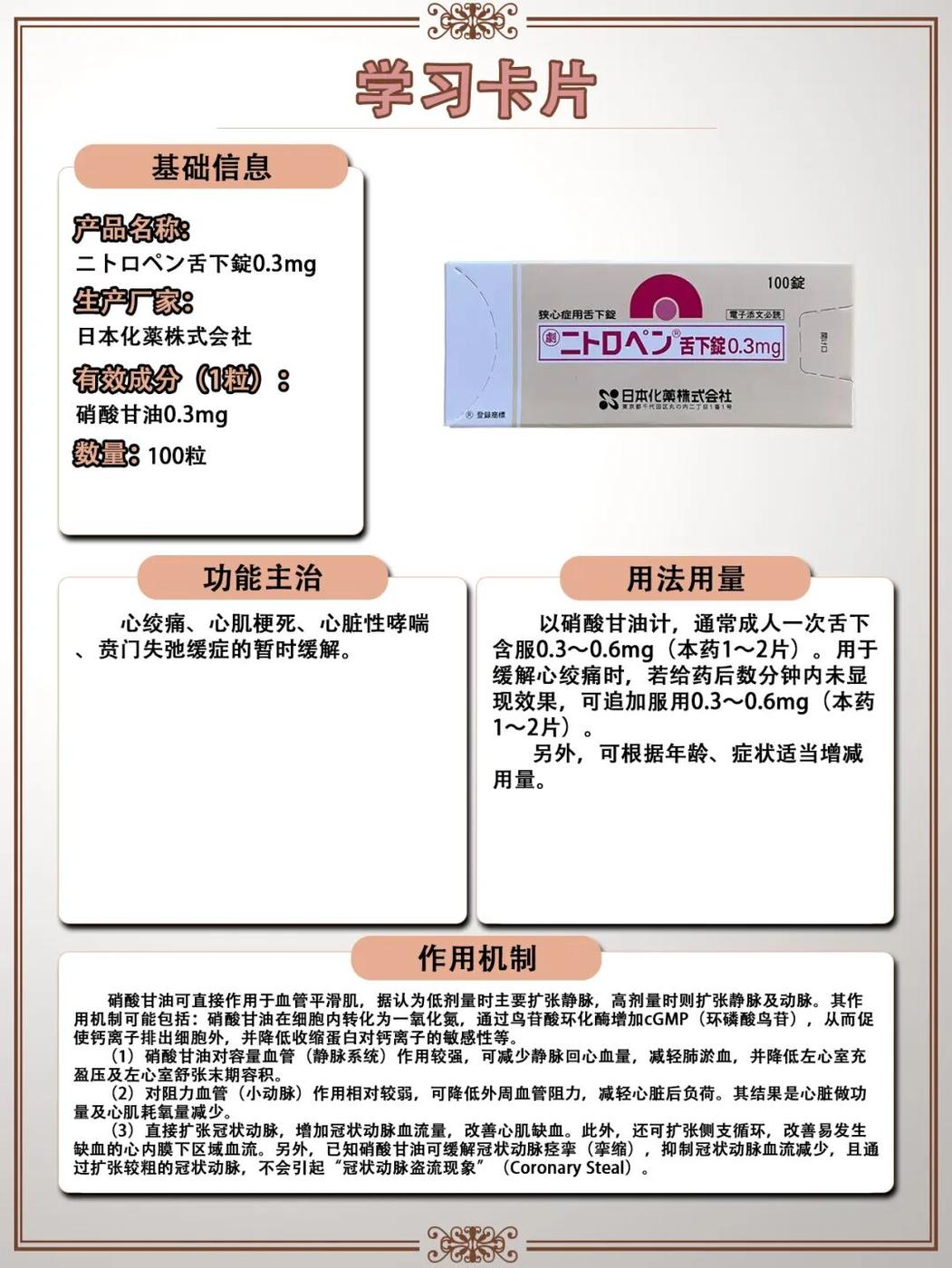
日本語原題:ニトロペン舌下錠0.3mg
Each tablet contains 0.3 mg of nitroglycerin.
Source images
1 imagesThe artwork keeps its original Japanese/Chinese lettering. Open “Text in this image” under a picture to read what it says in your language (machine-read, may contain errors).
Text in this image machine-read · may contain errors
Basic information Product Name: Nitropen sublingual tablets 0.3mg 100 ingots Manufacturer: Nippon Kayaku Co., Ltd Er Shangkou Ren sublingual tablets 0.3mg Active ingredient (1 capsule): Nitroglycerin 0.3 mg Quantity: 100 capsules Functions and indications Usage and dosage Angina, myocardial infarction, cardiac asthma Calculated as nitroglycerin, adults usually use sublingual therapy once and temporary relief of achalasia in the door aphasia. Take 0.3~0.6mg (1~2 tablets of this medicine). Used for When relieving angina, if not visible within a few minutes after administration The current effect is present. An additional dose of 0.3~0.6mg (this medicine) can be added 1~2 tablets). Additionally, adjustments can be adjusted appropriately according to age and symptoms Dosage. Mechanism of action Nitroglycerin acts directly on vascular smooth muscle; it is believed that at low doses it mainly dilates veins, while at high doses it dilates veins and arteries. Its creation Possible mechanisms include: nitroglycerin being converted into nitric oxide inside cells, increasing cGMP (cyclic guanosine phosphate) through guanylate cyclase, thereby promoting Helps expel calcium ions from cells and reduces the sensitivity of contractile proteins to calcium ions. (1) Nitroglycerin has a strong effect on the volume vessels (venous system), reducing venous return to the heart, alleviating pulmonary congestion, and lowering left ventricular filling Fullness and left ventricular end-diastolic volume. (2) It has relatively weak effects on resistance vessels (small arteries), can reduce peripheral vascular resistance, and lessen cardiac afterload. The result is the heart doing work and myocardial oxygen consumption decreased. (3) Directly dilate the coronary arteries, increase coronary blood flow, and improve myocardial ischemia. Additionally, it can dilate collateral circulation and improve the likelihood of infection Ischemic blood flow in the subendocardial region. Additionally, nitroglycerin is known to relieve coronary artery contracture, inhibit reduced coronary blood flow, and promote Overdilating the wider coronary artery does not cause "coronary steal."
基础信息 产品名称: ニトロペン舌下錠 O.3mg 100锭 生产厂家: 日本化藥株式会社 二上口人舌下锭0.3mg 有效成分(1粒): 硝酸甘油0.3mg 数量:100粒 功能主治 用法用量 心绞痛、心肌梗死、心脏性哮喘 以硝酸甘油计,通常成人一次舌下 、门失弛缓症的暂时缓解。 含服0.3~0.6mg(本药1~2片)。用于 缓解心绞痛时,若给药后数分钟内未显 现效果,可追加服用0.3~0.6mg(本药 1~2片)。 另外,可根据年龄、症状适当增减 用量。 作用机制 硝酸甘油可直接作用于血管平滑肌,据认为低剂量时主要扩张静脉,高剂量时则扩张静脉及动脉。其作 用机制可能包括:硝酸甘油在细胞内转化为一氧化氮,通过鸟苷酸环化酶增加cGMP(环磷酸鸟苷),从而促 使钙离子排出细胞外,并降低收缩蛋白对钙离子的敏感性等。 (1)硝酸甘油对容量血管(静脉系统)作用较强,可减少静脉回心血量,减轻肺淤血,并降低左心室充 盈压及左心室舒张末期容积。 (2)对阻力血管(小动脉)作用相对较弱,可降低外周血管阻力,减轻心脏后负荷。其结果是心脏做功 量及心肌耗氧量减少。 (3)直接扩张冠状动脉,增加冠状动脉血流量,改善心肌缺血。此外,还可扩张侧支循环,改善易发生 缺血的心内膜下区域血流。另外,已知硝酸甘油可缓解冠状动脉挛(挛缩),抑制冠状动脉血流减少,且通 过扩张较粗的冠状动脉,不会引起“冠状动脉盗流现象”(CoronarySteal)。
Basic information Product Name: Nitropen sublingual tablets 0.3mg 100 ingots Manufacturer: Nippon Kayaku Co., Ltd Er Shangkou Ren sublingual tablets 0.3mg Active ingredient (1 capsule): Nitr…