Pemafibrate
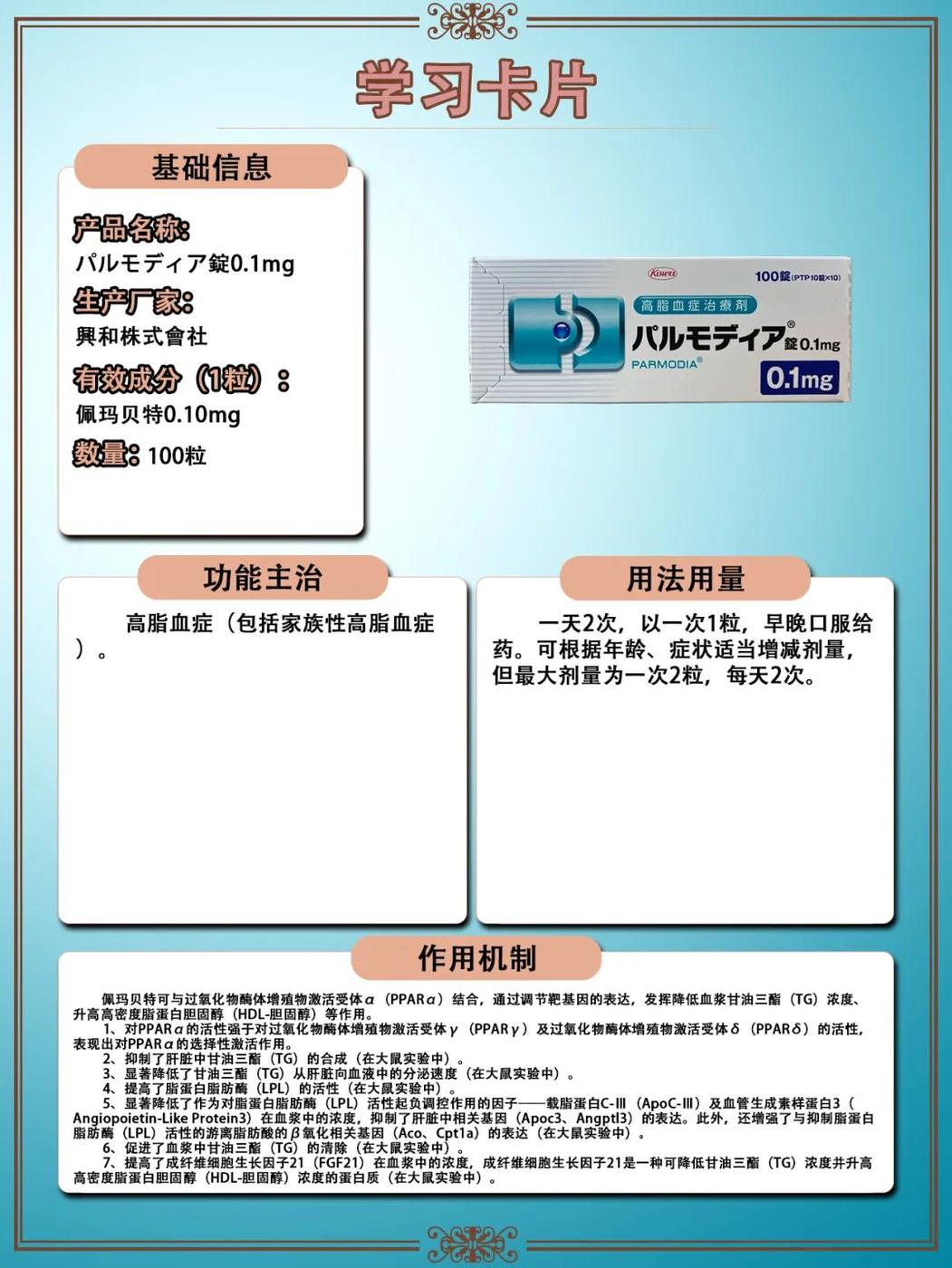
日本語原題:パルモディア錠0.1mg
Each tablet contains 0.10 mg of pemafibrate.
Source images
1 imagesThe artwork keeps its original Japanese/Chinese lettering. Open “Text in this image” under a picture to read what it says in your language (machine-read, may contain errors).
Text in this image machine-read · may contain errors
Basic information Product Name: Ba'er Mao Ge Tablet 0.1mg 100 spindles (PTP10 Lingx10) Manufacturer: Kowa Co., Ltd PARMODIA 0.1mg Active ingredient (1 capsule): Pemafibrate 0.10mg Quantity: 100 capsules Functions and indications Usage and dosage Hyperlipidemia (including familial hyperlipidemia). Take one capsule twice a day, morning and evening Medicine. Dosage can be adjusted appropriately according to age and symptoms, But the maximum dose is 2 capsules per dose, twice daily. Mechanism of action Pemafiter can bind to peroxisome proliferator-activated receptor α (PPARα), and by regulating the expression of target genes, it can reduce plasma triglyceride (TG) concentrations, Increases high-density lipoprotein cholesterol (HDL cholesterol) and other effects. 1. Its activity against PPARα is stronger than that on peroxisome proliferator-activated receptors (PPAR) and peroxisome-proliferative activators (PPARs), It exhibits selective activation of PPARα. 2. Inhibited the synthesis of triglycerides (TG) in the liver (in rat experiments). 3. Significantly reduced the secretion rate of triglycerides (TG) from the liver into the bloodstream (in rat experiments). 4. Increased activity of lipoprotein lipase (LPL) (in rat experiments) 5. Significantly reduces factors that negatively regulate lipoprotein lipase (LPL) activity 1. Apolipoprotein C-I (ApoC-I) and angiopoietin-like protein 3 ( Angiopoietin-like Protein3) in plasma inhibits the expression of related genes (Apoc3, Angptl3) in the liver. Additionally, it enhances lipoprotein inhibition Expression of β oxidation-related genes (Aco, Cpt1a) of free fatty acids with lipase (LPL) activity (in rat experiments). 6. Promotes clearance of triglycerides (TG) in plasma (in rat experiments) 7. Increased plasma concentration of fibroblast growth factor 21 (FGF21), which can lower and elevate triglyceride (TG) levels High-density lipoprotein cholesterol (HDL cholesterol) concentration in the protein (in rat experiments).
基础信息 产品名称: 八儿毛亍个锭0.1mg 100锭(PTP10菱X10) 生产厂家: 興和株式會社 PARMODIA 0.1mg 有效成分(1粒): 佩玛贝特0.10mg 数量:100粒 功能主治 用法用量 高脂血症(包括家族性高脂血症 一天2次,以一次1粒,早晚口服给 药。可根据年龄、症状适当增减剂量, 但最大剂量为一次2粒,每天2次。 作用机制 佩玛贝特可与过氧化物酶体增殖物激活受体α(PPARα)结合,通过调节靶基因的表达,发挥降低血浆甘油三酯(TG)浓度、 升高高密度脂蛋白胆固醇(HDL-胆固醇)等作用。 1、对PPARα的活性强于对过氧化物酶体增殖物激活受体(PPAR)及过氧化物酶体增殖物激活受体(PPARS)的活性, 表现出对PPARα的选择性激活作用。 2、抑制了肝脏中甘油三酯(TG)的合成(在大鼠实验中)。 3、显著降低了甘油三酯(TG)从肝脏向血液中的分泌速度(在大鼠实验中)。 4、提高了脂蛋白脂肪酶(LPL)的活性(在大鼠实验中) 5、显著降低了作为对脂蛋白脂肪酶(LPL)活性起负调控作用的因子 一载脂蛋白C-I(ApoC-I)及血管生成素样蛋白3( Angiopoietin-LikeProtein3)在血浆中的浓度,抑制了肝脏中相关基因(Apoc3、Angptl3)的表达。此外,还增强了与抑制脂蛋白 脂肪酶(LPL)活性的游离脂肪酸的β氧化相关基因(Aco、Cpt1a)的表达(在大鼠实验中)。 6、促进了血浆中甘油三酯(TG)的清除(在大鼠实验中) 7、提高了成纤维细胞生长因子21(FGF21)在血浆中的浓度,成纤维细胞生长因子21是一种可降低甘油三酯(TG)浓度并升高 高密度脂蛋白胆固醇(HDL-胆固醇)浓度的蛋白质(在大鼠实验中)。
Basic information Product Name: Ba'er Mao Ge Tablet 0.1mg 100 spindles (PTP10 Lingx10) Manufacturer: Kowa Co., Ltd PARMODIA 0.1mg Active ingredient (1 capsule): Pemafibrate 0.10mg Quantity: …