Neuro & Psychiatric · NERVOUS

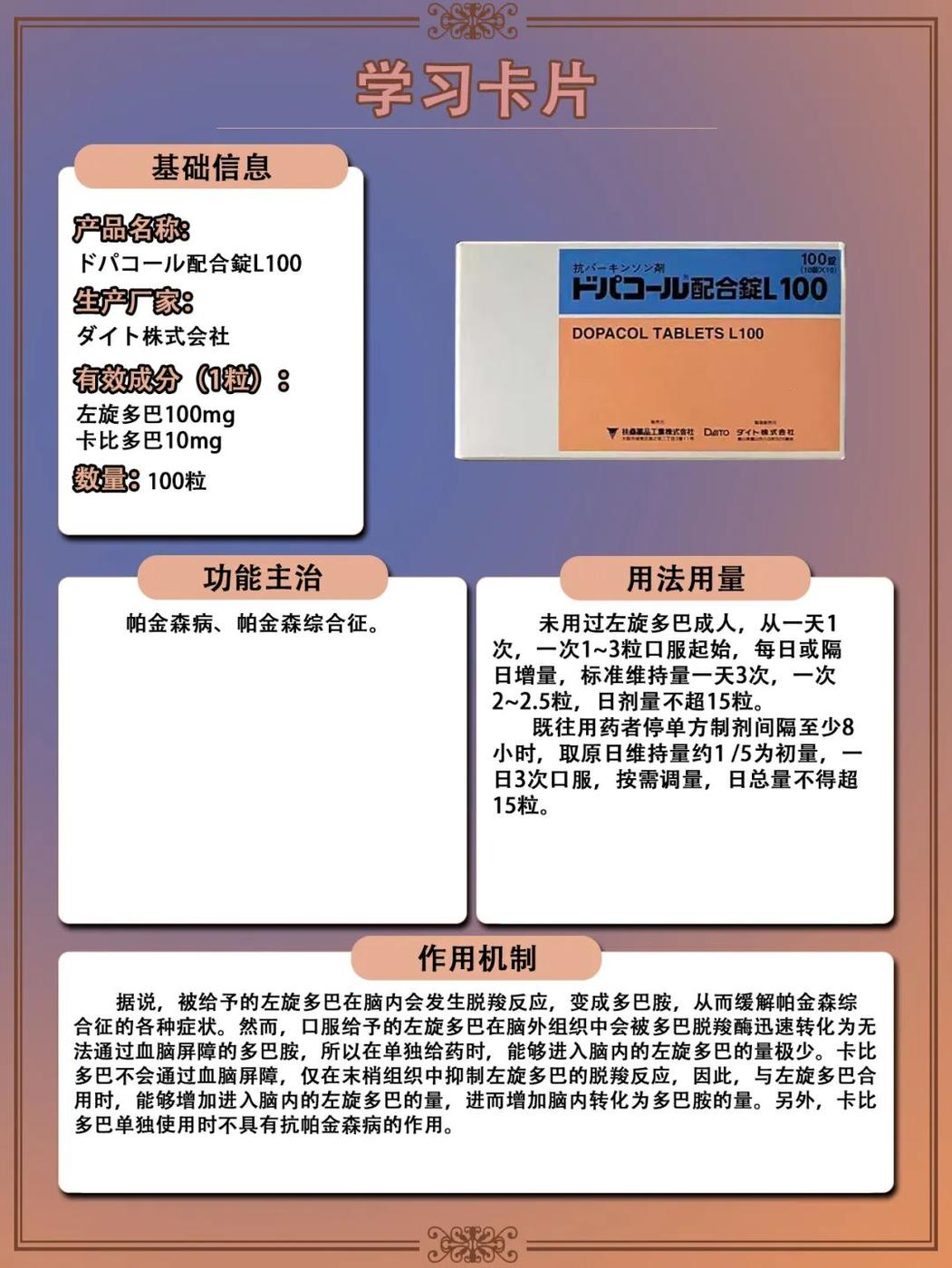
Levodopa + carbidopa

日本語原題:ドパコール配合錠L100

Published2026-11-28 15:26 FormTablet Content9 sections / 1 images
Ingredients / strength:
Each tablet contains 100mg of levodopa (Japanese formula), 10.8mg of carbidopa hydrate (Japanese formula) (10mg as anhydrous).
English translation of the Japanese package insert is the main text; the Japanese original is shown alongside for verification. Use the language menu (top right) to read the page in another language. This site is for reference only — consult a doctor or pharmacist before use.
Section 1 · 01
English translation
Feature Description Levodopa is a precursor to dopamine, which is said to be closely related to the pathophysiology of Parkinson's disease. It crosses the blood-brain barrier and is taken up in the brain, where it is converted into dopamine to exert physiological effects, and is said to be effective for Parkinson's disease and Parkinson's syndrome. Carbidopa hydrate is an inhibitor of levodopa decarboxylase; it does not cross the blood-brain barrier itself and does not enter the brain; when administered together with levodopa, it prevents decarboxylation outside the brain and enhances its translocation to the brain. Additionally, since levodopa is not affected by the conversion of levodopa into dopamine, it increases dopamine levels in the brain.
Section 2 · 02
English translation
100 tablets [10 tablets (aluminum-plastic blister packaging) ×10 boards].
Section 3 · 03
English translation
Characteristics A pale red oval lock with a split line.
Section 4 · 04
English translation
Ingredient Information Active ingredient: Levodopa (Japanese formula) 100mg per tablet, Carbidopa hydrate (Japanese formula) 10.8mg (10mg as anhydrous form). Additives: crystalline cellulose, corn starch, hydroxypropyl cellulose, povidone, steary.
Section 5 · 05
English translation
Indications Parkinson's disease, Parkinson's syndrome.
Section 6 · 06
English translation
Dosage and Administration 1. Patients who have not taken levodopa: For adults, start with oral administration of 100~125mg per dose of levodopa, 100~300mg daily, and increase daily or every other day to 100~125mg to determine the optimal dosage and maintain the dose (standard maintenance dose is 200~250mg per dose, three times daily). The amount may be adjusted appropriately depending on symptoms, but the levodopa dose should not exceed 1500 mg per day. 2. Patients already taking levodopa: For adults, after taking the Levodopa mono-flavor formulation, at least an 8-hour interval is administered, then the initial dose is set at about one-fifth of the daily maintenance levodopa dose, divided into three oral doses per day. Afterward, adjust the optimal dosage as appropriately based on symptoms, and set the maintenance dose (standard maintenance dose is 200~250 mg per levodopa dose, three times a day), but the levodopa dose should not exceed 1500 mg per day.
Section 7 · 07
English translation
Notes 1. If there is a risk of angle-closure glaucoma, it is advisable to perform a corner examination or intraocular pressure test. 2. Long-term administration of levodopa preparations may cause the following phenomena, so appropriate measures should be taken. (1) If wearing off (up and down) symptoms occur, take measures such as increasing the number of doses within the daily dosage range. (2) If on-and-off symptoms occur, gradually reduce the maintenance dose or discontinue the medication. If symptoms worsen, other antiparkinsonian drugs should be used in combination with other treatments. 3. Sudden sleep without warning may occur, somnolence, regulatory disorders, and decreased attention, concentration, or reflex functions. Therefore, patients receiving this drug should be careful not to engage in operating dangerous machinery such as driving a vehicle. 4. When using with selegiline hydrochloride or similar (type B monoamine oxidase inhibitors), always refer to the electronic addendum of selegiline hydrochloride or similar products before use. 5. Pathological gambling (a state where gambling persistently occurs despite socially adverse outcomes such as personal life collapse), pathological increased libido, compulsive buying, and binge eating have been reported due to administration of levodopa or dopamine receptor agonists. Additionally, in patients treated with levodopa, impulse control disorders and dopamine dysregulation syndrome, where levodopa is taken exceeding the required amount, has been reported. Explain these symptoms to patients and their families, and if symptoms appear, take appropriate measures such as dose reduction or discontinuation of administration. 6. Hemolytic anemia and thrombocytopenia may occur, so regular blood tests should be performed.
Section 8 · 08
English translation
Side Effects 1. Malignant syndrome (frequency unknown) Rapid dose reduction or discontinuation may cause high fever, impaired consciousness, severe muscle rigidity, involuntary movements, and shock; in such cases, after redosing, gradually reduce the dose, and appropriate measures such as body cooling and hydration should be taken. 2. Confusion (frequency unknown), hallucinations (frequency unknown), depression (frequency unknown) 3. Hemolytic anemia (frequency unknown), thrombocytopenia (frequency unknown) 4. Sudden sleep episodes (frequency unknown) Sudden sleep without warning may occur. 5. Angle-closure glaucoma (frequency unknown) Since angle obstruction glaucoma accompanied by a sudden increase in intraocular pressure may occur, if foggy vision, eye pain, redness, headache, nausea, etc., discontinue administration and provide appropriate treatment immediately. 6. Other side effects (1) Neuropsychiatric system: involuntary movements (31.8%), insomnia, anxiety/restlessness, dizziness, headache, taste disturbances, delusions, drowsiness, fatigue/weakness, disorientation, pathological gambling, pathological hyperlibido, dopamine dysregulation syndrome, gait disturbances, increased excitement, tremor, numbness. (2) Gastrointestinal: nausea (11.9%), vomiting, loss of appetite, dry mouth, constipation, abdominal pain, diarrhea, abdominal bloating, abdominal discomfort, swallowing difficulties, heartburn, excessive salivation, stomatitis. (3) Urinary system: abnormal urination, urinary tract infections. (4) Blood: granulocytopenia, anemia. (5) Hypersensitivity: rash. (6) Cardiovascular system: arrhythmia, elevated blood pressure, orthostatic hypotension, palpitations, hypotension. (7) Eyes: Visual abnormalities. (8) Liver: increased AST, increased ALT, increased LDH, increased ALP. (9) Kidneys: edema, increased BUN. (10) Others: hot flashes, sweating, muscle pain, weight loss, discoloration of sputum, oral mucosa, sweat, urine, feces, saliva, etc. (black, etc.), positive cases of anti-DNA antibodies, positive Coombs test cases, hair loss, hoarseness.
Section 9 · 09
English translation
taboo 1. Patients with angle-closure glaucoma [may experience increased intraocular pressure and worsen symptoms. ] 2. Patients with a history of hypersensitivity to any component of this drug

Source images

1 images

Need help sourcing Japanese medicines or OEM production?

💬