Digestive · DIGESTIVE

Lansoprazole Sodium

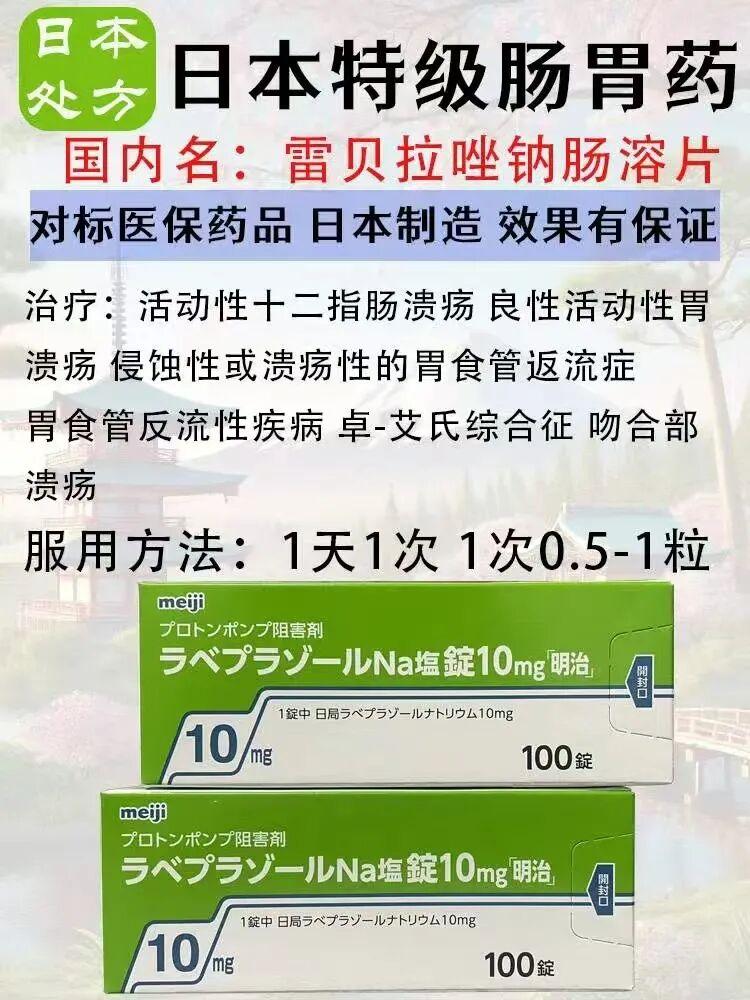
日本語原題:ラベプラゾールNa塩錠10mg「明治」

Published2025-06-07 01:39 FormTablet Content9 sections / 2 images
English translation of the Japanese package insert is the main text; the Japanese original is shown alongside for verification. Use the language menu (top right) to read the page in another language. This site is for reference only — consult a doctor or pharmacist before use.
Section 1 · 01
English translation
Feature Description This drug acts as an active substance (sulfenamide form) in the acidic region of acid-secreting cells, modifies the SH group of proton pumps (H+, K+-ATPase), inhibits enzyme activity, and suppresses acid secretion. Furthermore, the recovery of inhibited enzyme activity is mainly involved in the loss of drugs from the site of action or the elimination of active substances due to glutathione. Additionally, it is speculated that glutathione may restore enzyme activity.
Section 2 · 02
English translation
Specifications PTP packaging (with desiccant) 100 tablets (10 tablets × 10).
Section 3 · 03
English translation
Characteristics Pale yellow film-coated tablets (enteric-coated tablets).
Section 4 · 04
English translation
Ingredient Information Active ingredient (per tablet): Nippon Rabeprazole Sodium 10mg. Additives: D-mannitol, calcium silicate, sodium hydroxide, hydroxypropyl cellulose, low-substitution hydroxypropyl cellulose, magnesium stearate, hypromellose, talc, polyvinyl alcohol, acrylic acid, methyl methacrylate copolymer, methacrylate copolymer LD, sodium lauryl sulfate, polysorbate 80, triethyl citrate , titanium oxide, yellow ferric oxide, carnauba wax.
Section 5 · 05
English translation
Indications 1. Gastric ulcer, duodenal ulcer, anastomotic ulcer, reflux esophagitis, Zollinger-Ellison syndrome, nonerosive gastroesophageal reflux disease, and recurrence suppression of gastric or duodenal ulcers during low-dose aspirin administration 2. Assistance in the removal of Helicobacter pylori in the following cases: Gastric ulcer, duodenal ulcer, gastric MALT lymphoma, idiopathic thrombocytopenic purpura, and early gastric cancer after endoscopic treatment of the stomach, Helicobacter pylori gastritis.
Section 6 · 06
English translation
Dosage and Administration 1. "Gastric ulcer, duodenal ulcer, anastomotic ulcer, Zollinger-Ellison syndrome" Typically, adults receive 10 mg of rabeprazole sodium orally once daily, but depending on the condition, 20 mg can be administered orally once daily. Usually, administration is limited to 8 weeks for gastric ulcers and anastomotic ulcers, and up to 6 weeks for duodenal ulcers. 2. "Reflux Esophagitis" (1) Treatment In the treatment of reflux esophagitis, adults are usually given 10 mg of rabeprazole sodium orally once daily, but depending on the condition, 20 mg can be given orally once daily. Normally, administration is limited to up to 8 weeks. If proton pump inhibitor treatment is insufficient, oral administration of 10 mg or 20 mg twice daily for 8 weeks may be performed. However, 20 mg twice daily is only recommended in cases of severe mucosal injury. (2) Maintenance therapy In maintenance therapy for reflux esophagitis with repeated relapses and flare-ups, adults are typically given 10 mg of rabeprazole sodium orally once daily. Additionally, for maintenance therapy of reflux esophagitis where proton pump inhibitor treatment is insufficient, 10 mg per dose can be administered orally twice daily. 3. Non-erosive Gastroesophageal Reflux Disease Typically, adults are given 10 mg of rabeprazole sodium orally once daily. Normally, administration is limited to up to 4 weeks. 4. Suppression of recurrence of gastric or duodenal ulcers during low-dose aspirin administration Typically, adults receive 5 mg of rabeprazole sodium orally once daily, but if efficacy is insufficient, 10 mg can be administered orally once daily. 5. Assistance in Sterilizing Helicobacter pylori Typically, adults are given three oral doses simultaneously: 10 mg rabeprazole sodium, 750 mg amoxicillin hydrate (potency) per dose, and clarithromycin 200 mg (potency) twice daily for 7 days. Clarithromycin can be increased as needed. However, the maximum is 400mg (potency) twice a day. If the eradication of Helicobacter pylori by triple administration of proton pump inhibitor, amoxicillin hydrate, and clarithromycin is unsuccessful, alternative treatments typically include three drugs simultaneously twice daily for adults: 10 mg rabeprazole sodium once, 750 mg once as amoxicillin hydrate (potency), and 250 mg metronidazole twice daily. Administered orally for 7 days.
Section 7 · 07
English translation
Notes 1. "Common Efficacy" During administration of this drug, it is advisable to monitor blood tests and liver function, and to perform regular hematological and biochemical tests. 2. 〈Gastric ulcer, duodenal ulcer, anastomotic ulcer, nonerosive gastroesophageal reflux disease〉 Since long-term usage experience is insufficient, it is preferable not to use it for maintenance therapy. 3. Maintenance therapy for reflux esophagitis This should be performed on patients who repeatedly experience relapses or flare-ups, or those who are insufficiently responsive to proton pump inhibitor therapy, and be careful not to perform it on patients who do not normally require maintenance therapy. Additionally, if lifestyle habits such as dietary restrictions and alcohol intake are improved and remission persists for a long time, medication withdrawal or weight reduction should be considered. During maintenance therapy, it is desirable to conduct thorough observations such as regular endoscopy. 4. Non-erosive Gastroesophageal Reflux Disease Confirm through medical examination that repeated acid reflux symptoms such as heartburn or acid reflux (at least 2 days per week) are present before administration. Please note that administration of this drug may mask symptoms caused by malignant tumors such as gastric and esophageal cancer, as well as other gastrointestinal diseases, so confirm by endoscopy or other examinations that these diseases are not present.
Section 8 · 08
English translation
Side Effects 1. Shock (frequency unknown), anaphylaxis (frequency unknown) 2. Pancytopenia (frequency unknown), agranulocytosis (frequency unknown), thrombocytopenia (less than 0.1%), hemolytic anemia (frequency unknown) 3. Fulminant hepatitis (frequency unknown), liver dysfunction (less than 0.1~5%), jaundice (frequency unknown) 4. Interstitial pneumonia (less than 0.1%) If fever, cough, difficulty breathing, abnormal lung sounds (twisted sounds), etc., promptly perform chest X-ray or other examinations, discontinue administration of this drug, and take appropriate measures such as administering corticosteroids. 5. Skin disorders (frequency unknown) Toxic epidermal necrolysis (TEN), Stevens-Johnson syndrome, erythema multiforme, and others may occur. 6. Acute kidney injury (frequency unknown), interstitial nephritis (frequency unknown) Be cautious with kidney function tests (BUN, creatinine, etc.). 7. Hyponatremia (frequency unknown) 8. Rhabdomyolysis (frequency unknown) Rhabdomyolysis, characterized by muscle pain, weakness, increased CK, and elevated myoglobin in blood and urine, may appear. 9. Visual impairment (frequency unknown) 10. Confused state (frequency unknown) Delirium, abnormal behavior, disorientation, hallucinations, anxiety, impatience, aggression, and other symptoms may appear. 11. Other side effects 〈Suppression of gastric ulcers, duodenal ulcers, anastomotic ulcers, reflux esophagitis, Zollinger-Ellison syndrome, non-erosive gastroesophageal reflux disease, and recurrence of gastric or duodenal ulcers during low-dose aspirin administration (1) Hypersensitivity: rash, itching, urticaria. (2) Blood: leukopenia, leukopenia, eosinophilia, anemia, erythrocytopenia, neutrophilia, lymphopenia. (3) Liver: Increased AST, ALT, AlP, γ-GTP, LDH, and increased total bilirubin. (4) Cardiovascular system: increased blood pressure, palpitations. (5) Digestive system: constipation, diarrhea, abdominal bloating, nausea, stomatitis, abdominal pain, bitter taste, candidiasis, bloating, dry mouth, loss of appetite, bloating, glossitis, vomiting, microscopic colitis (collagenous colitis, lymphocytic colitis). (6) Psychiatric and nervous system: headache, dizziness, dizziness, drowsiness, limb weakness, sensory dullness, decreased grip strength, mouth congestion, disorientation, delirium, coma. (7) Others: Increased total cholesterol, triglycerides, and BUN, proteinuria, increased blood TSH, blurred vision, edema, fatigue, fever, alopecia, numbness, increased CK, flickering eyes, joint pain, muscle pain, hyperammonemia, hypomagnesemia, gynecomastia. 〈Assistance in Sterilizing Helicobacter pylori〉 (1) Hypersensitivity: rash, hives, itching. (2) Blood: leukopenia, eosinophilia, neutropenia, lymphopenia, lymphocytosis, thrombocytopenia, leukocytosis. (3) Liver: Elevated ALT, AST, γ-GTP, and elevated Al-P and LDH. (4) Cardiovascular system: Palpitations, elevated blood pressure. (5) Digestive system: diarrhea, soft stools, taste disturbances, abdominal pain, abdominal bloating, nausea, constipation, glossitis, stomach discomfort, bloating and flatulence, dry mouth, stomatitis, heartburn, cheilitis, hemorrhoids, esophagitis, loss of appetite, enteritis. (6) Neuropsychiatric system: headache, dizziness. (7) Others: increased triglycerides, facial edema, fatigue, numbness of the tongue, warmth, proteinuria, increased intraocular pressure, numbness in hands and feet, increased uric acid, abnormal uric sugar, increased erectile function.
Section 9 · 09
English translation
taboo 1. Patients with a history of hypersensitivity to any component of this drug 2. Patients receiving rilpivirin hydrochloride

Source images

2 images

Need help sourcing Japanese medicines or OEM production?

💬