Warfarin Potassium
日本語原題:ワーファリン錠1mg/5mg
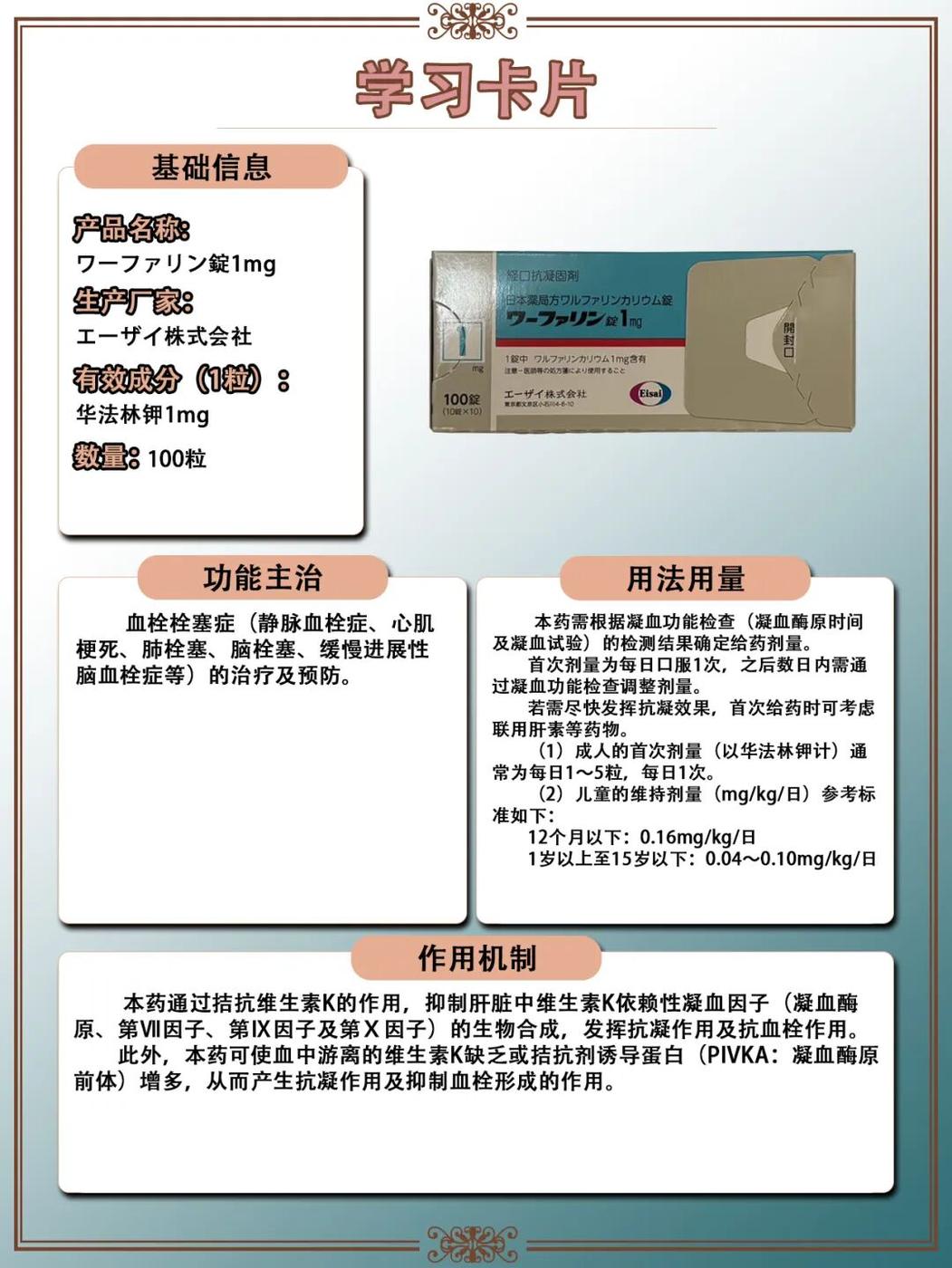
Each tablet contains 1mg of warfarin potassium.
Source images
2 imagesThe artwork keeps its original Japanese/Chinese lettering. Open “Text in this image” under a picture to read what it says in your language (machine-read, may contain errors).
Text in this image machine-read · may contain errors
Basic information Product Name: Warfarin tablets 1mg Oral anticoagulants Manufacturer: Japanese Pharmacopoeia Warfarin Potassium Ole Koichi Sako Co., Ltd - Presence of kotsurufarin and potassium (caravulin). Active ingredient (1 capsule): Warfarin potassium 1mg Quantity: 100 capsules Functions and indications Usage and dosage Thromboembolism (venous thrombosis, myocardial disease This drug should be tested based on coagulation function (prothrombin time). and blood test results to determine the dosage. Infarction, pulmonary embolism, cerebral embolism, and slow progression The initial dose is once daily orally, followed by a bowel movement within several days Treatment and prevention of cerebral thrombosis, etc. Adjust the dose for hypercoagulation tests. If anticoagulant effects need to be acted quickly, it can be considered during the first administration Combined use of heparin and other medications. (1) Initial adult dose (calculated as warfarin potassium) for passing Usually 1~5 capsules daily, once daily. (2) Reference reference for maintenance dose (mg/kg/day) for children The standard is as follows: Under 12 months: 0.16 mg/kg/day From 1 year old to under 15 years: 0.04~0.10mg/kg/day Mechanism of action This drug works by antagonizing the effects of vitamin K, inhibiting vitamin K-dependent coagulation factor (thrombin) in the liver Biosynthesis of progenitor, factor VI, factor IX, and factor X), exerting anticoagulant and antithrombotic effects. Additionally, this drug can reduce free vitamin K deficiency in the blood or the induced protein (PIVKA: prothrombin). precursors) increase, thereby producing anticoagulant effects and inhibiting thrombosis.
基础信息 产品名称: ワーファリン錠 lmg 经口抗凝固剂 生产厂家: 日本薬局方ワルファリンカリウム齪 工一サ个株式会社 ー甲つルファリンカリつム有 有效成分(1粒): 华法林钾1mg 数量:100粒 功能主治 用法用量 血栓栓塞症(静脉血栓症、心肌 本药需根据凝血功能检查(凝血酶原时间 及血试验)的检测结果确定给药剂量。 梗死、肺栓塞、脑栓塞、缓慢进展性 首次剂量为每日口服1次,之后数日内需通 脑血栓症等)的治疗及预防。 过凝血功能检查调整剂量。 若需尽快发挥抗凝效果,首次给药时可考虑 联用肝素等药物。 (1)成人的首次剂量(以华法林钾计)通 常为每日1~5粒,每日1次。 (2)儿童的维持剂量(mg/kg/日)参考标 准如下: 12个月以下:0.16mg/kg/日 1岁以上至15岁以下:0.04~0.10mg/kg/日 作用机制 本药通过拮抗维生素K的作用,抑制肝脏中维生素K依赖性凝血因子(凝血酶 原、第VI因子、第IX因子及第X因子)的生物合成,发挥抗凝作用及抗血栓作用。 此外,本药可使血中游离的维生素K缺乏或拮抗剂诱导蛋白(PIVKA:凝血酶原 前体)增多,从而产生抗凝作用及抑制血栓形成的作用。
Basic information Product Name: Warfarin tablets 1mg Oral anticoagulants Manufacturer: Japanese Pharmacopoeia Warfarin Potassium Ole Koichi Sako Co., Ltd - Presence of kotsurufarin and potas…
Text in this image machine-read · may contain errors
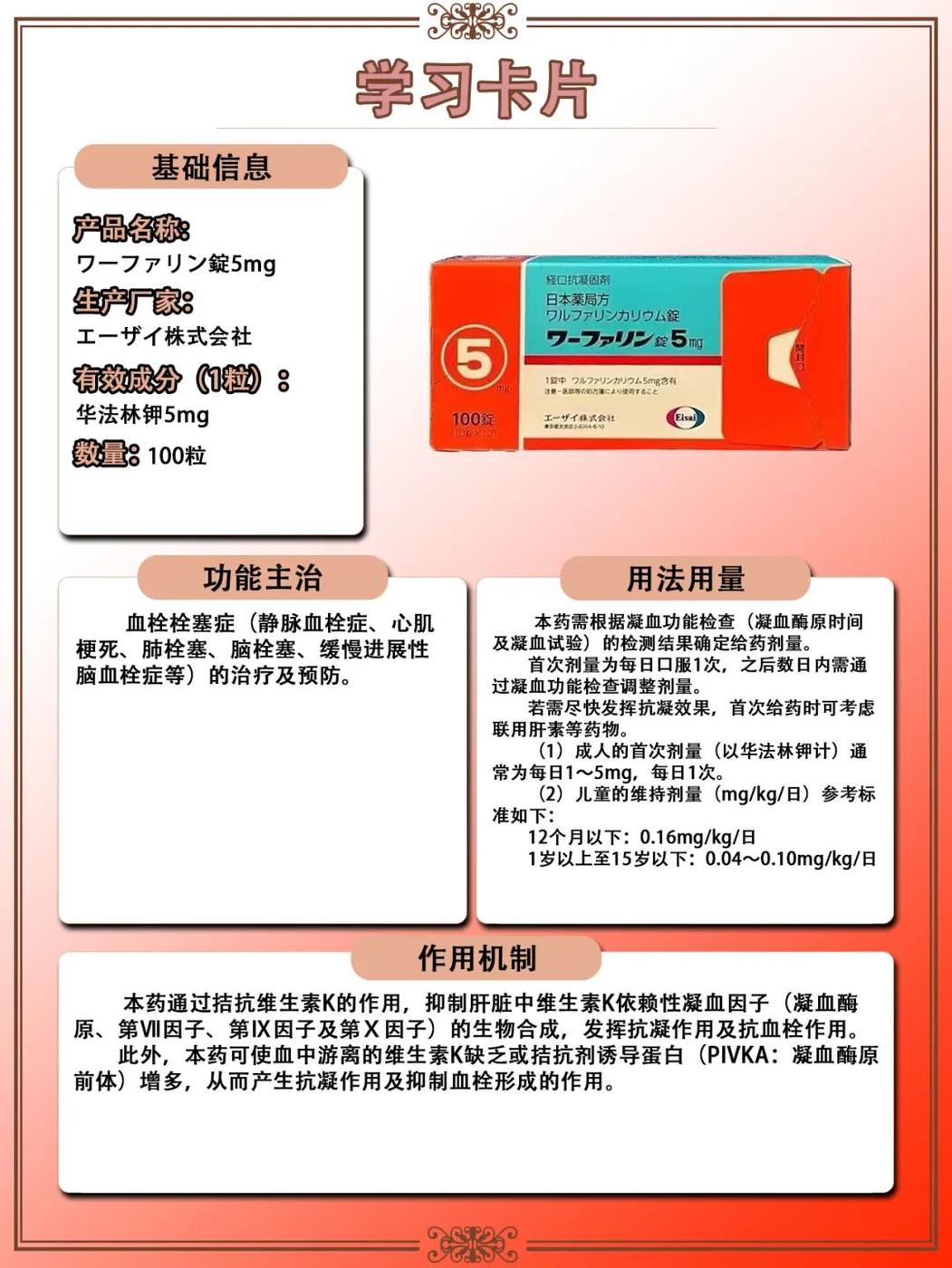
Basic information Product Name: Warfarin tablets 5mg Manufacturer: Japanese leaf bureau Warfarin potassium tablets Active ingredient (1 capsule): Includes 10 Nakatsurufu, 7 Rinkaritsumu, and 51 pieces Warfarin potassium 5mg 100% off Quantity: 100 capsules Functions and indications Usage and dosage Thromboembolism (venous thrombosis, myocardial disease This drug should be tested based on coagulation function (prothrombin time). and blood test results to determine the dosage. Infarction, pulmonary embolism, cerebral embolism, and slow progression The initial dose is once daily orally, followed by a bowel movement within several days Treatment and prevention of cerebral thrombosis, etc. Adjust the dose for hypercoagulation tests. If anticoagulant effects need to be acted quickly, it can be considered during the first administration Combined use of heparin and other medications. (1) Initial adult dose (calculated as warfarin potassium) for passing Usually, 1~5mg per day, once daily. (2) Reference reference for maintenance dose (mg/kg/day) for children The standard is as follows: Under 12 months: 0.16 mg/kg/day From 1 year old to under 15 years: 0.04~0.10mg/kg/day Mechanism of action This drug works by antagonizing the effects of vitamin K, inhibiting vitamin K-dependent coagulation factor (thrombin) in the liver Biosynthesis of progenitor, factor VI, factor X, and factor X), exerting anticoagulant and antithrombotic effects. Additionally, this drug can reduce free vitamin K deficiency in the blood or the induced protein (PIVKA: prothrombin). precursors) increase, thereby producing anticoagulant effects and inhibiting thrombosis.
基础信息 产品名称: ワーファリン錠 5mg 生产厂家: 日本葉局方 ワルファリンカリウム錠 有效成分(1粒): 10 中つルフ 7 リンカリつム 51 含 华法林钾5mg 100折 数量:100粒 功能主治 用法用量 血栓栓塞症(静脉血栓症、心肌 本药需根据凝血功能检查(凝血酶原时间 及血试验)的检测结果确定给药剂量。 梗死、肺栓塞、脑栓塞、缓慢进展性 首次剂量为每日口服1次,之后数日内需通 脑血栓症等)的治疗及预防。 过凝血功能检查调整剂量。 若需尽快发挥抗凝效果,首次给药时可考虑 联用肝素等药物。 (1)成人的首次剂量(以华法林钾计)通 常为每日1~5mg,每日1次。 (2)儿童的维持剂量(mg/kg/日)参考标 准如下: 12个月以下:0.16mg/kg/日 1岁以上至15岁以下:0.04~0.10mg/kg/日 作用机制 本药通过拮抗维生素K的作用,抑制肝脏中维生素K依赖性凝血因子(凝血酶 原、第VI因子、第X因子及第X因子)的生物合成,发挥抗凝作用及抗血栓作用。 此外,本药可使血中游离的维生素K缺乏或拮抗剂诱导蛋白(PIVKA:凝血酶原 前体)增多,从而产生抗凝作用及抑制血栓形成的作用。
Basic information Product Name: Warfarin tablets 5mg Manufacturer: Japanese leaf bureau Warfarin potassium tablets Active ingredient (1 capsule): Includes 10 Nakatsurufu, 7 Rinkaritsumu, and…