Pyridoxine Hydrochloride
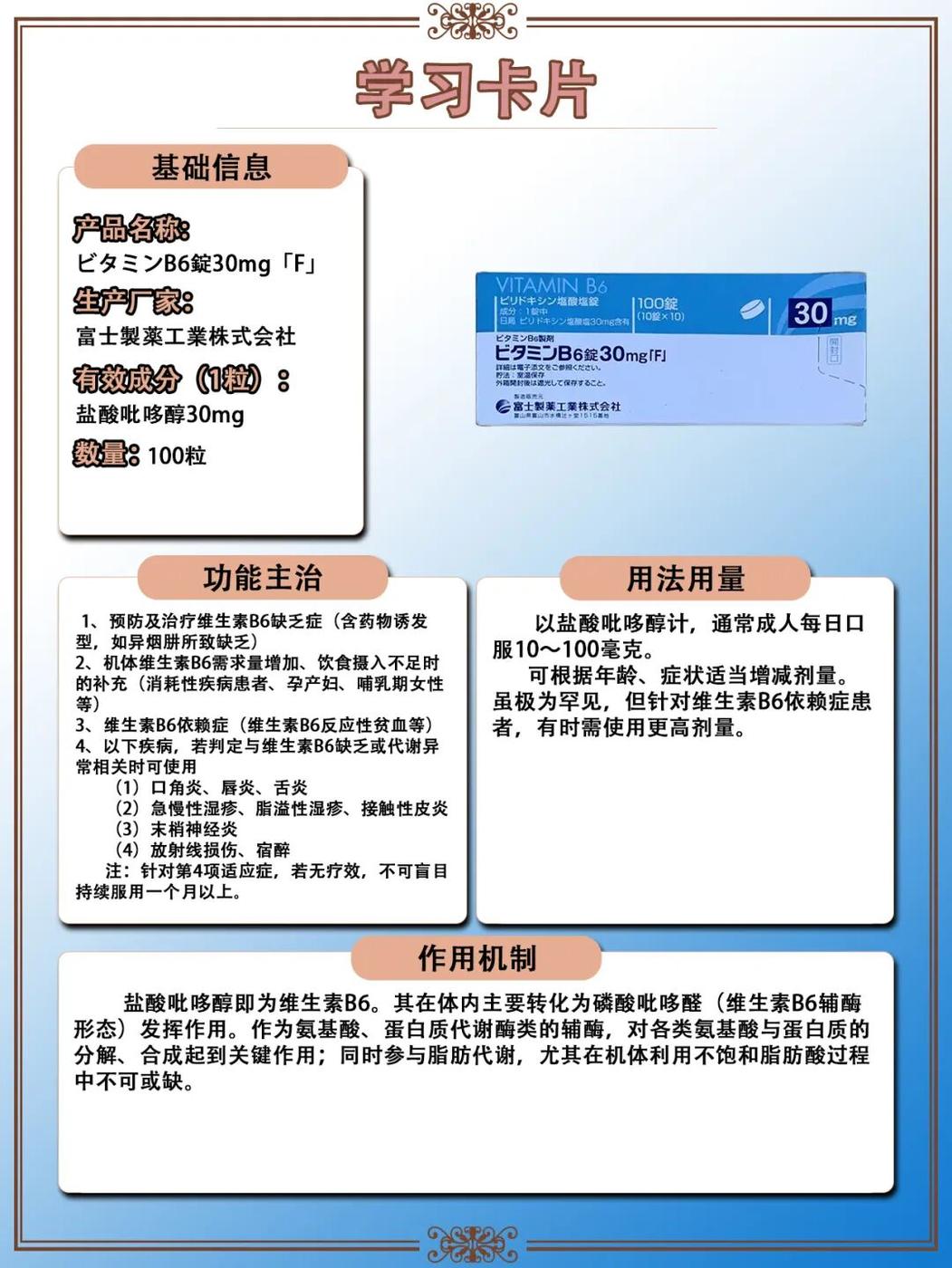
日本語原題:ビタミンB6錠30mg「F」
1 tablet Chunichi Bureau Pyridoxine Hydrochloride 30mg.
Source images
1 imagesThe artwork keeps its original Japanese/Chinese lettering. Open “Text in this image” under a picture to read what it says in your language (machine-read, may contain errors).
Text in this image machine-read · may contain errors
Basic information Product Name: Vitamin B6 Tablets 30mg "F" VITAMIN B6 Manufacturer: Explosive bilidoxin salt (10 Ling×10) Ribilitoxin 30 and 30 more Fuji Pharmaceutical Co., Ltd Vitamin 8 is also a source Active ingredient (1 capsule): 30mg pyridoxine hydrochloride Fuji Somako Technique-style Company Quantity: 100 capsules Functions and indications Usage and dosage 1. Prevention and treatment of vitamin B6 deficiency (including drug-induced symptoms). Calculated in pyridoxine hydrochloride, the average daily intake is typical for adults Deficiency caused by isoniazid) Take 10~100 mg. 2. When the body's demand for vitamin B6 increases and dietary intake is insufficient Dosage can be adjusted appropriately according to age and symptoms. supplements (patients with wasting diseases, pregnant and postpartum women, breastfeeding women). Although extremely rare, it is used for those with vitamin B6 dependence sometimes require higher doses. 3. Vitamin B6 dependence (such as vitamin B6-reactive anemia) 4. If the following diseases are diagnosed as vitamin B6 deficiency or metabolic abnormalities, Can be used when frequently related (1) Angular cheilitis, cheilitis, glossitis (2) Acute and chronic eczema, seborrheic eczema, contact dermatitis (3) Peripheral neuritis (4) Radiation injury, hangover Note: For indication 4, if there is no efficacy, do not apply blindly Take it continuously for more than one month. Mechanism of action Pyridoxine hydrochloride is vitamin B6. In the body, it is mainly converted into pyridal phosphate (vitamin B6 coenzyme). Form) plays a role. As a coenzyme for amino acids and protein metabolism enzymes, it is responsible for the effects of various amino acids and proteins Decomposition and synthesis play a key role; It also participates in fat metabolism, especially in the body's utilization of unsaturated fatty acids and the center must not be lacking.
基础信息 产品名称: ビタミン B6 錠 30mg 「 F 」 VITAMIN B6 生产厂家: ビリドキシン塩爆齪 (10菱×10) リビリトキシン第物ま 30 い & をれ 富士製藥工業株式会社 ビタミン 8 し製第 有效成分(1粒): 盐酸吡哆醇30mg 富士装茉工抹式会社 数量:100粒 功能主治 用法用量 1、预防及治疗维生素B6缺乏症(含药物诱发 以盐酸吡哆醇计,通常成人每日口 型,如异烟肼所致缺乏) 服10~100毫克。 2、机体维生素B6需求量增加、饮食摄入不足时 可根据年龄、症状适当增减剂量。 的补充(消耗性疾病患者、孕产妇、哺乳期女性 虽极为罕见,但针对维生素B6依赖症患 者,有时需使用更高剂量。 3、维生素B6依赖症(维生素B6反应性贫血等) 4、以下疾病,若判定与维生素B6缺乏或代谢异 常相关时可使用 (1)口角炎、唇炎、舌炎 (2)急慢性湿疹、脂溢性湿疹、接触性皮炎 (3)末梢神经炎 (4)放射线损伤、宿醉 注:针对第4项适应症,若无疗效,不可盲目 持续服用一个月以上。 作用机制 盐酸吡哆醇即为维生素B6。其在体内主要转化为磷酸吡醛(维生素B6辅酶 形态)发挥作用。作为氨基酸、蛋白质代谢酶类的辅酶,对各类氨基酸与蛋白质的 分解、合成起到关键作用;同时参与脂肪代谢,尤其在机体利用不饱和脂肪酸过程 中不可或缺。
Basic information Product Name: Vitamin B6 Tablets 30mg "F" VITAMIN B6 Manufacturer: Explosive bilidoxin salt (10 Ling×10) Ribilitoxin 30 and 30 more Fuji Pharmaceutical Co., Ltd Vitamin 8 i…