Digestive · DIGESTIVE

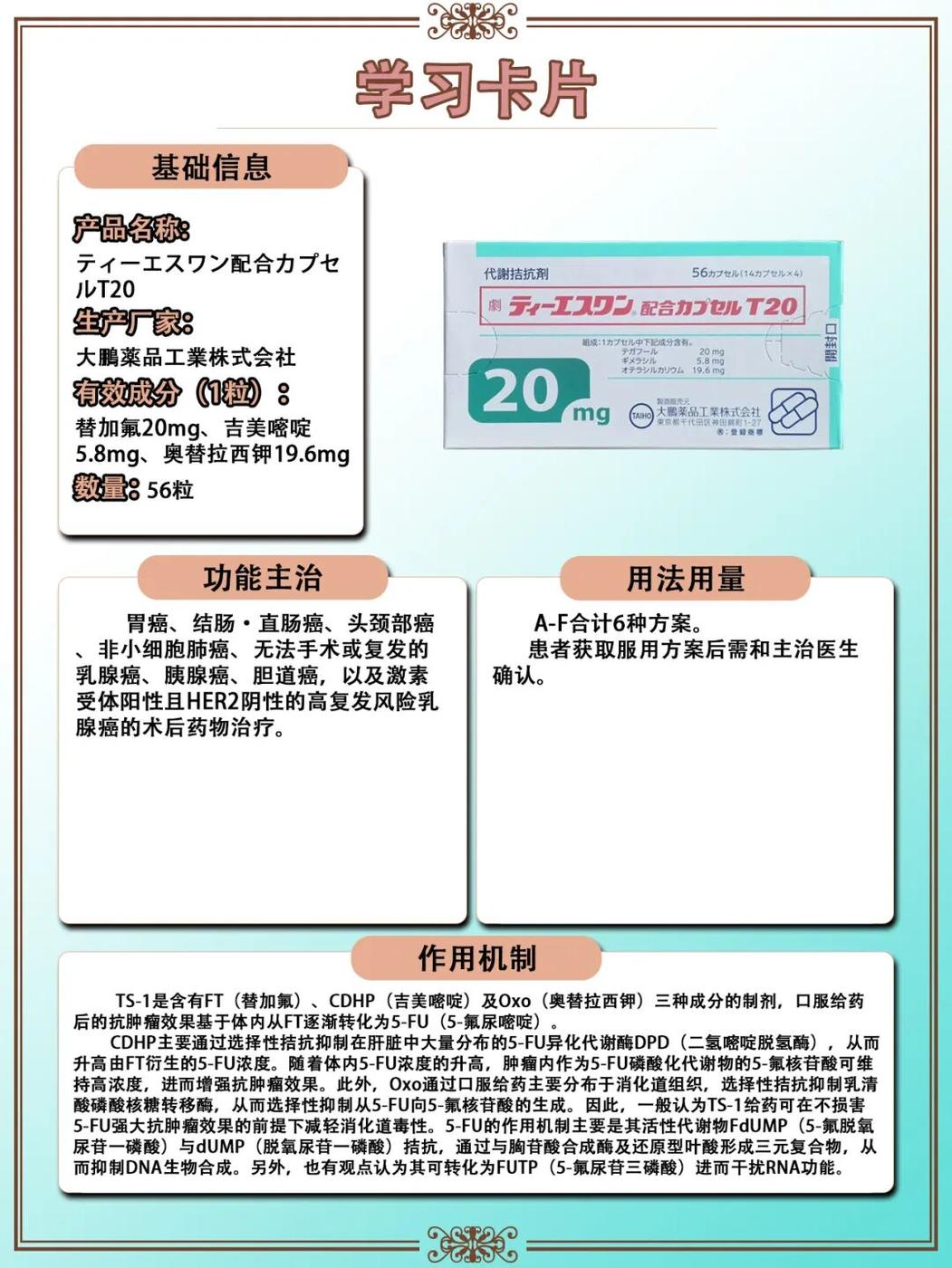
Tegaflu + dimpyrimidine + otiracetic potassium

日本語原題:ティーエスワン配合カプセルT20

Published2026-07-05 09:06 FormCapsule Content10 sections / 6 images
Ingredients / strength:
In one capsule, Tegafur 20mg, Gimeracil 5.8mg, and Oteracyl Potassium 19.6mg.
English translation of the Japanese package insert is the main text; the Japanese original is shown alongside for verification. Use the language menu (top right) to read the page in another language. This site is for reference only — consult a doctor or pharmacist before use.
Section 1 · 01
English translation
Feature Description TS-1 is a formulation containing FT, CDHP, and Oxo, and its oral antitumor effect is based on 5-FU, which is gradually converted from FT in the body. CDHP primarily increases the concentration of 5-FU derived from FT by selectively antagonizing and inhibiting the DPD of the 5-FU catabolic enzyme widely distributed in the liver. As the concentration of 5-FU increases in the body, 5-fluoronucleotide, a phosphorylated metabolite of 5-FU, remains high within tumors, enhancing its antitumor effect. Additionally, when administered orally, Oxo is distributed mainly in gastrointestinal tissues and selectively antagonizes orotatephosphoribosyltransferase, thereby selectively suppressing the production of 5-FU to 5-fluoronucleotide. As a result, it is believed that TS-1 administration reduces gastrointestinal toxicity without impairing the strong antitumor effect of 5-FU. The mechanism of action of 5-FU mainly involves the active metabolite FdUMP antagonizing dUMP and forming an intercellular complex with thymidylatesynthase and reduced folate to inhibit DNA biosynthesis. It is also said to be converted to FUTP, which impairs RNA function.
Section 2 · 02
English translation
Specifications PTP packaging: 56 capsules (14 capsules ×4).
Section 3 · 03
English translation
Characteristics It is a white, opaque hard capsule containing a white powder and granules.
Section 4 · 04
English translation
Ingredient Information Active ingredients: per capsule, tegafur 20mg, gimeracil 5.8mg, oteracyl potassium 19.6mg. Additives: lactose hydrate, magnesium stearate, gelatin, sodium lauryl sulfate, titanium oxide.
Section 5 · 05
English translation
Indications Postoperative drug therapy for gastric cancer, colon and rectal cancer, head and neck cancer, non-small cell lung cancer, inoperable or recurrent breast cancer, pancreatic cancer, biliary tract cancer, and hormone receptor-positive and HER2-negative high-risk recurrence breast cancer.
Section 6 · 06
English translation
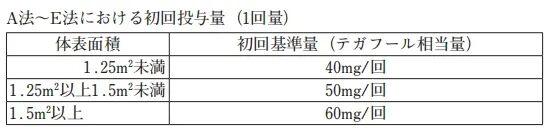
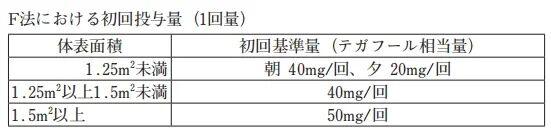
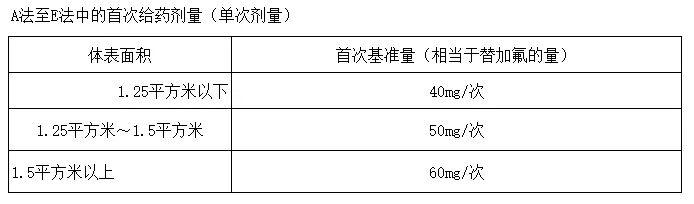
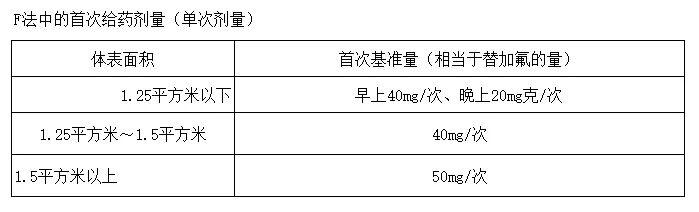
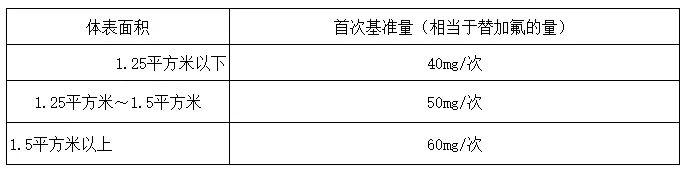
Dosage and Administration 1. (Stomach cancer, colon/rectal cancer, head and neck cancer, non-small cell lung cancer, inoperable or recurrent breast cancer, pancreatic cancer, biliary tract cancer) For gastric cancer, use Method A, Method B, or Method C; for colon/rectal cancer, Method A, Method C, or Method D; for head and neck cancer, Method A; for non-small cell lung cancer, Method A, Method B, or Method C; for inoperable or recurrent breast cancer, Method A; for pancreatic cancer, Method A or Method; and for biliary tract cancer, Method A, Method, or F. Method A: Typically, adults receive the initial dose (single dose) based on body surface area as the reference amount in the table below, administered orally twice daily after breakfast and dinner for 28 consecutive days, then discontinued for 14 days. This is repeated as a single course. Adjust the amount appropriately depending on the patient's condition. Dose increase is limited to one step from the initial reference dose when there are no abnormalities in clinical laboratory values (blood tests, liver and kidney function tests) or gastrointestinal symptoms determined by administration, and there is no safety concern and it is judged that the dose can be increased, with a maximum of 75 mg per dose. Method B: Typically, adults receive the initial dose (single dose) based on body surface area as the reference amount in the table below, administered orally twice daily after breakfast and dinner for 21 consecutive days, then take a 14-day break. This is repeated as a single course. Dose reduction is adjusted as needed depending on the patient's condition. Method C: Typically, for adults, the initial dose (single dose) is set according to body surface area as the reference dose in the table below, administered orally twice daily after breakfast and dinner for 14 consecutive days, then taken off for 7 days. This is repeated as a single course. Dose reduction is adjusted as needed depending on the patient's condition. Method D: Typically, adults receive the initial dose (single dose) based on body surface area as the reference dose in the table below, administered orally twice daily after breakfast and dinner for 14 consecutive days, then suspended for 14 days. This is repeated as a single course. Dose reduction is adjusted as needed depending on the patient's condition. Method E: Normally, adults receive the first dose (single dose) based on body surface area as the reference dose in the table below, administered orally twice daily after breakfast and dinner for 7 consecutive days, then suspended for 7 days. This is repeated as a single course. Dose reduction is adjusted as needed depending on the patient's condition. Method F: Normally, adults receive the initial dose (single dose) based on body surface area as the reference amount in the table below, administered orally twice daily after breakfast and dinner for 14 consecutive days, then take a 7-day break. This is repeated as a single course. Dose reduction is adjusted as needed depending on the patient's condition. 2. Postoperative Drug Therapy for Hormone Receptor-Positive and HER2-Negative Breast Cancer with High Risk of Recurrence When used in combination with endocrine therapy agents, adults are typically given orally twice daily after breakfast and dinner for 14 consecutive days, then taken off for 7 days. This is treated as a single course and administered repeatedly for up to one year. Adjust the amount appropriately depending on the patient's condition. Do not increase the dose beyond the initial standard amount.
Section 7 · 07
English translation
Notes 1. Severe infections (such as sepsis) caused by bone marrow suppression have been reported resulting in death from septic shock or disseminated intravascular coagulation. Therefore, be especially cautious about the onset or worsening of infection or bleeding tendencies. 2. Interstitial pneumonia may develop or worsen with administration of this drug, which can be fatal. Therefore, confirm the presence or absence of interstitial pneumonia during administration, closely monitor clinical symptoms such as respiratory condition, cough, and fever during administration, and perform chest X-ray examinations. In particular, non-small cell lung cancer tends to present lung disorders such as interstitial pneumonia more frequently than other cancers. 3. Hepatitis caused by reactivation of the hepatitis B virus may occur after administration of this drug; therefore, confirm the presence of hepatitis virus infection before administration and take appropriate measures before administration. 4. To avoid serious side effects such as bone marrow suppression and fulminant hepatitis, perform clinical tests (blood tests, liver and kidney function tests, etc.) at least once every two weeks before starting each course and during the treatment period, and closely monitor the patient's condition. Perform clinical tests frequently, especially during the first course and during dose increases.
Section 8 · 08
English translation
Side Effects 1. Bone marrow suppression, hemolytic anemia Severe bone marrow suppression such as pancytopenia, agranulocytosis (symptoms: fever, sore throat, fatigue, etc.) (frequency unknown), leukopenia (46.7%), anemia (frequency unknown), thrombocytopenia (15.7%) may occur, and hemolytic anemia (frequency unknown). [ 2. Disseminated intravascular coagulation (DIC) (0.4%) If abnormalities are found in blood tests such as platelet count, serum FDP levels, or plasma fibrinogen concentration, discontinue administration and take appropriate measures. 3. Severe liver damage such as fulminant hepatitis Severe liver damage such as fulminant hepatitis (including those caused by reactivation of the hepatitis B virus) (frequency unknown) may occur. 4. Dehydration symptoms Severe diarrhea may occur, potentially leading to dehydration (frequency unknown); if such symptoms appear, discontinue administration and provide appropriate fluids or other measures. 5. Severe enteritis (0.5%) Hemorrhagic enteritis, ischemic enteritis, necrotizing enteritis, etc. may occur, so if severe abdominal pain or diarrhea occurs, discontinue administration and take appropriate treatment. 6. Interstitial pneumonia Interstitial pneumonia (0.3%) Note 1) (Early symptoms: cough, shortness of breath, difficulty breathing, fever, etc.) may appear. If abnormalities are observed, discontinue administration, perform chest X-rays and other examinations, and take appropriate measures such as steroid therapy. 7. Myocardial infarction, angina pectoris, arrhythmia, heart failure Myocardial infarction, angina, arrhythmias (including ventricular tachycardia), and heart failure (all of unknown frequency) may occur; therefore, if chest pain, fainting, palpitations, abnormal ECG, shortness of breath, etc., discontinue administration and take appropriate treatment. 8. Severe stomatitis (frequency unknown), gastrointestinal ulcers (0.5%), gastrointestinal bleeding (0.3%), gastrointestinal perforation (frequency unknown) If abnormalities are observed, discontinue administration, perform necessary examinations such as abdominal X-rays, and take appropriate measures. 9. Acute kidney injury, nephrotic syndrome (frequency unknown) 10. Toxic Epidermal Necrolysis (TEN), Stevens-Johnson syndrome (both frequency unknown) 11. Neuropsychiatric disorders including leukoencephalopathy Leukoencephalopathy (mainly symptoms such as impaired consciousness, cerebellar ataxia, and dementia-like symptoms), consciousness disturbances, disorientation, somnolence, memory decline, extrapyramidal symptoms, speech disorders, limb paralysis, gait disturbances, urinary incontinence, and sensory disturbances (all of unknown frequency) may occur. 12. Acute pancreatitis (frequency unknown) If abdominal pain or elevated serum amylase levels occur, discontinue administration and take appropriate measures. 13. Rhabdomyolysis Rhabdomyolysis (frequency unknown) may occur, characterized by muscle pain, weakness, increased CK, and elevated myoglobin in blood and urine. Also, be cautious of the onset of acute kidney damage caused by rhabdomyolysis. 14. Loss of smell Olfactory disturbances (0.1%) may occur, and it can lead to loss of smell (frequency unknown). 15. Lacrimal duct obstruction (frequency unknown) There have been reports of surgical procedures. If symptoms such as tearing appear, perform an ophthalmic examination and take appropriate measures. 16. Cirrhosis (prolonged prothrombin time, decreased albumin, decreased cholinesterase, etc.) (frequency unknown) 17. Other side effects (1) Blood: leukopenia, neutropenia, thrombocytopenia, erythrocytopenia, hemoglobin decrease, hematocrit decrease, lymphopenia, bleeding tendency (subcutaneous hemorrhage, nosebleeds, coagulation factor abnormalities), eosinophilia, leukocytosis. (2) Liver: increased AST, increased ALT, increased bilirubin, increased Al-P, jaundice, and positive urinary urobilinogen. (3) Kidneys: increased BUN, increased creatinine, proteinuria, hematuria. (4) Digestive system: loss of appetite, nausea and vomiting, diarrhea, stomatitis, taste disorders, intestinal obstruction, ileus, abdominal pain, abdominal bloating, epigastric pain, gastritis, abdominal rumbling, white stools, constipation, angular cheilitis, cheilitis, glossitis, dry mouth. (5) Skin: pigmentation, erythema, scaling, flushing, blisters, hand-foot syndrome (Note 2), skin ulcers, dermatitis, hair loss, nail abnormalities, perinailitis, herpes simplex, dry and rough skin, photosensitivity, DLE-like rash. (6) Hypersensitivity: rash, itching. (7) Neuropsychiatric system: general fatigue, numbness, headache, heaviness in the head, dizziness, dizziness, and peripheral neuropathy. (8) Cardiovascular system: low blood pressure, elevated blood pressure, abnormal ECG, Raynaud's symptoms, palpitations. (9) Eyes: tearing, conjunctivitis, keratitis, corneal erosion, eye pain, decreased vision, dry eyes, corneal ulcers, corneal opacity, and limous stem cell deficiency. (10) Others: elevated LDH, decreased total protein, decreased albumin, fever, generalized fever, rhinitis, pharyngitis, phlegm, diabetes, elevated blood sugar, edema, muscle pain, elevated CK, joint pain, electrolyte imbalances (elevated serum sodium, decreased serum sodium, elevated serum potassium, decreased serum potassium, elevated serum calcium, decreased serum calcium, decreased serum chlor, decreased serum crawl), weight loss, Serum amylase levels increase.
Section 9 · 09
English translation
taboo 1. Patients with a history of severe hypersensitivity to any component of this drug 2. Patients with severe bone marrow suppression [there is a risk of enhanced bone marrow suppression. ] 3. Patients with severe renal impairment [Renal excretion of the catabolic enzyme inhibitor gimeracil of fluorouracil is significantly reduced, blood fluorouracil concentration increases, and there is a risk of strong side effects such as bone marrow suppression. ] 4. Patients with severe liver impairment [There is a risk of worsening liver damage. ] 5. Patients currently receiving other pyrimidine fluoride antineoplastic agents (including combination therapies with these drugs) 6. Patients receiving flucytosine 7. Pregnant women or women who may be pregnant
Section 10 · 10
English translation
Warning 1. Cancer chemotherapy containing this drug should only be performed in cases where this therapy is deemed appropriate under the guidance of a physician with sufficient knowledge and experience in cancer chemotherapy, at medical facilities capable of adequate emergency response. When selecting eligible patients, be very careful by referring to the electronic appendix of each combination drug. Also, before starting treatment, fully explain the efficacy and risks to the patient or their family, and only administer after obtaining consent. 2. This drug differs from conventional oral fluorouracil drugs in that its dose-limiting toxicity (DLT) is bone marrow suppression, so special attention must be paid to clinical test values. Conduct clinical tests frequently. 3. Severe liver damage such as fulminant hepatitis can occur, so regular liver function tests and thorough observation are necessary to strive for early detection of liver damage. Pay close attention to the appearance of fatigue or other symptoms such as loss of appetite, which may be considered signs or subjective symptoms of liver damage, and if jaundice (jaundice of the eyeball) appears, immediately discontinue administration and take appropriate measures. 4. Do not use with other fluorinated pyrimidine antineoplastic agents, combination therapy with these drugs (such as horinate, tegafur, uracil therapy), or with the antifungal drug flucytosin, as there is a risk of serious blood disorders or other side effects.

Source images

6 images

Need help sourcing Japanese medicines or OEM production?

💬