Neuro & Psychiatric · NERVOUS

Dienogest

日本語原題:ジエノゲスト1mg

Published2026-08-08 09:47 FormPowder Content9 sections / 1 images
English translation of the Japanese package insert is the main text; the Japanese original is shown alongside for verification. Use the language menu (top right) to read the page in another language. This site is for reference only — consult a doctor or pharmacist before use.
Section 1 · 01
English translation
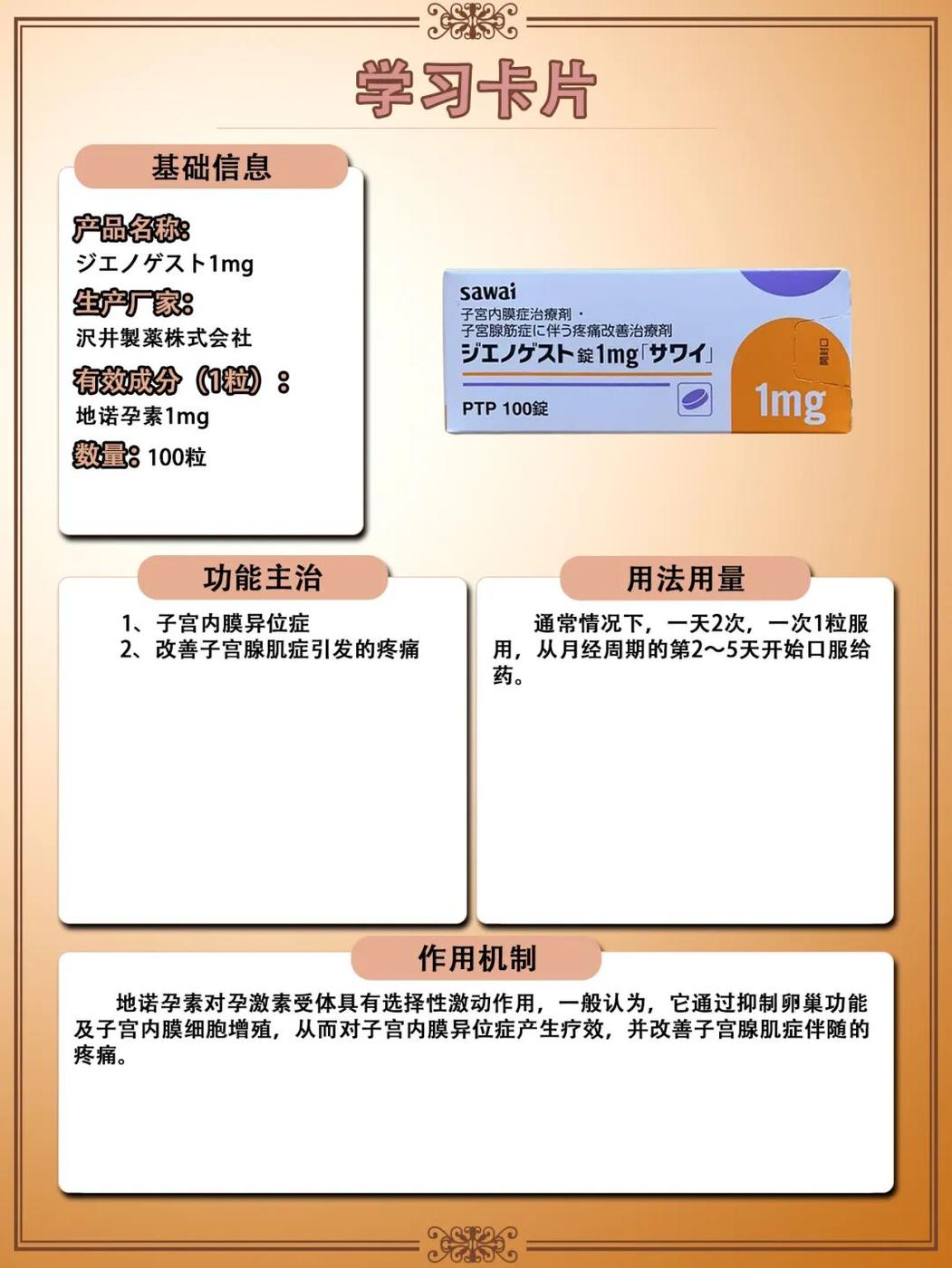
Feature Description Dienogest exhibits selective agonist action on progesterone receptors, and is thought to show efficacy against endometriosis and pain relief associated with adenomyosis by suppressing ovarian function and suppressing endometrial cell proliferation.
Section 2 · 02
English translation
Aluminum-plastic blister packaging: 100 pieces (10 tablets× 10 blisters).
Section 3 · 03
English translation
Characteristics White film-coated tablets.
Section 4 · 04
English translation
Ingredient Information Active ingredient [per tablet]: Dienogest 1mg. Additives: crystalline cellulose, titanium oxide, magnesium stearate, sodium starchoglycholate, lactose, hydroxypropyl cellulose, hypromellose, partially alpha-starched, macrogol 6000.
Section 5 · 05
English translation
Indications 1. Endometriosis 2. Improvement of pain associated with adenomyosis
Section 6 · 06
English translation
Dosage and Administration Typically, adults receive 2 mg of Dienogest divided into two doses orally starting from days 2~5 of the menstrual cycle.
Section 7 · 07
English translation
Notes 1. When administering this drug, pay attention to differentiation from similar diseases (such as malignant tumors), and discontinue administration if the mass enlarges during administration or clinical symptoms do not improve. 2. Although ovarian chocolate cysts are infrequent, there are reports suggesting malignancy during natural courses, so regular imaging diagnostics and tumor marker tests should be performed, and the patient's condition should be closely monitored. 3. During administration of this drug, closely monitor the course of administration, and if the expected effect is not achieved, do not continue administration indiscriminately; consider other appropriate treatments. 4. After administration of this drug, abnormal uterine bleeding may occur, potentially leading to severe anemia. The severity of abnormal uterine bleeding varies from person to person; bleeding may persist during administration or occur heavily at once, so please pay attention to the following points. (1) Explain thoroughly to patients in advance, and instruct them to consult a doctor if the bleeding volume is large and lasts for a long time, or if a large amount of abnormal uterine bleeding occurs simultaneously. (2) For patients with anemia, treat anemia before administration of this drug as needed. (3) If abnormal uterine bleeding is observed, blood tests should be performed as needed to closely monitor the patient's condition. If abnormalities are observed, appropriate measures such as administering iron supplements, discontinuing this drug, or transfusing blood should be taken. (4) In domestic clinical trials involving endometriosis, the incidence of anemia in patients with adenomyosis or fibroids tended to be higher compared to those without adenomyosis or fibroids. 5. When administering this drug for extended periods, please pay attention to the following points. (1) Patients with persistent abnormal uterine bleeding should pay close attention to differentiating bleeding caused by similar diseases (such as malignant tumors) and regularly perform imaging diagnostics to fully monitor the patient's condition. Also, consider conducting pathological examinations such as cytology as necessary. (2) Since efficacy and safety for administration exceeding one year have not been established, administration beyond one year should only be performed when deemed therapeutic, and regular clinical tests (blood tests, bone salvity tests, etc.) should be performed to monitor the patient's condition. 6. Since administration of this drug has been reported to cause depressive symptoms similar to menopausal disorders, carefully monitor the patient's condition before using this drug.
Section 8 · 08
English translation
Side Effects 1. Severe abnormal uterine bleeding (frequency unknown), severe anemia (frequency unknown) After administration of this drug, abnormal uterine bleeding may occur, potentially leading to severe anemia. If the bleeding volume is large and lasts for a long time, or if a large volume of abnormal uterine bleeding occurs simultaneously, blood tests should be performed as needed and thorough observation should be conducted. If abnormalities are detected, appropriate measures such as administering iron supplements, discontinuing this drug, or transfusing blood should be taken. 2. Anaphylaxis (frequency unknown) Anaphylaxis (difficulty breathing, angioedema, hives, itching, etc.) may occur, so if such symptoms appear, discontinue administration and take appropriate measures. 3. Other side effects (1) Hypoestrogen symptoms: hot flashes (20.6%), headache, dizziness, palpitations, insomnia, sweating, anxiety, depression. (2) Uterus: abnormal uterine bleeding (88.3%), abdominal pain. (3) Breasts: Breast tightness, breast pain, milk secretion. (4) Skin: vulvar irritation and itching, acne, hair loss, dry skin. (5) Neuropsychiatric system: Sleepiness, irritability, migraines, numbness. (6) Hypersensitivity: rash, itching, etc. (7) Liver: abnormal liver function test values such as elevated AST, ALT, γ-GTP, and bilirubin. (8) Gastrointestinal: nausea, abdominal pain, constipation, diarrhea, stomach discomfort, abdominal bloating, vomiting, stomatitis. (9) Blood: anemia, decreased white blood cells. (10) Musculoskeletal system: back pain, decreased bone salt, stiff shoulders, joint pain. (11) Others: fatigue, weight gain, edema, fatigue, fever, elevated cholesterol, tinnitus, elevated blood sugar.
Section 9 · 09
English translation
taboo 1. Patients with abnormal genital bleeding with undiagnosed conditions [there is a risk of similar diseases such as malignant tumors]. ] 2. Pregnant women or women who may be pregnant 3. Patients with a history of hypersensitivity to any component of this drug 4. Patients with severe uterine enlargement or severe anemia [abnormal uterine bleeding may worsen and cause massive bleeding.] ]

Source images

1 images

Need help sourcing Japanese medicines or OEM production?

💬