Urology & Kidney · URINARY

Dutasteride

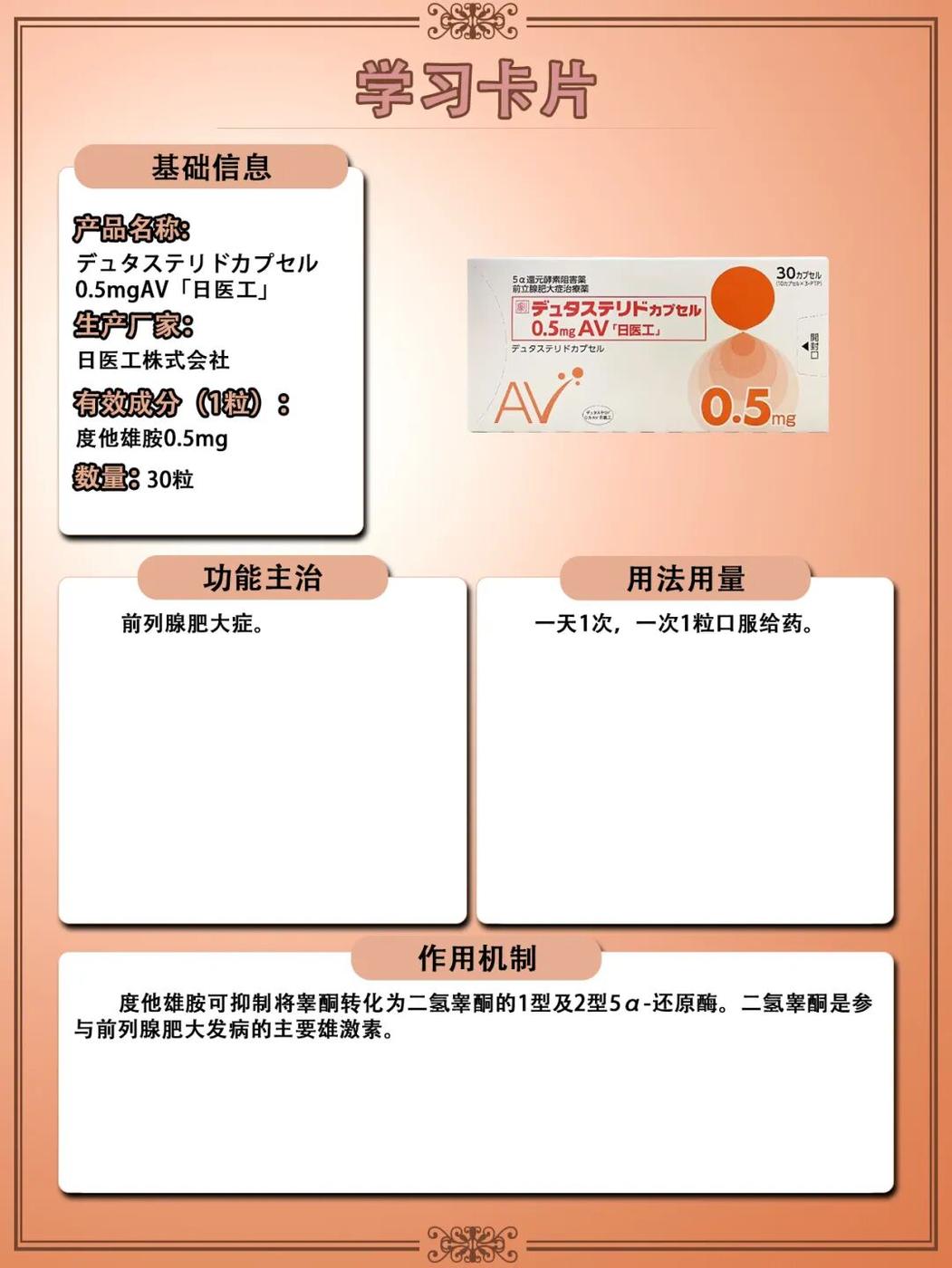
日本語原題:デュタステリドカプセル0.5mgAV「日医工」

Published2026-08-14 09:48 Maker日医工 FormCapsule Content9 sections / 1 images
Ingredients / strength:
Dutasteride 0.5 mg per capsule.
English translation of the Japanese package insert is the main text; the Japanese original is shown alongside for verification. Use the language menu (top right) to read the page in another language. This site is for reference only — consult a doctor or pharmacist before use.
Section 1 · 01
English translation
Feature Description Dutasteride inhibits type 1 and type 2 5α reductase that convert testosterone into dihydrotestosterone. Dihydrotestosterone is the main androgen involved in prostate enlargement.
Section 2 · 02
English translation
Specifications 30 capsules [10 capsules×3; PTP].
Section 3 · 03
English translation
Characteristics Dosage form: Soft capsule form with an oval sphere. Color and Properties: Pale yellow and opaque. Contents: Colorless clear ~ pale yellow clear oily liquid.
Section 4 · 04
English translation
Ingredient Information Active ingredient: 0.5mg of dutasteride per capsule. Additives: medium-chain mono-diglycerides, dibutyl hydroxytoluene, gelatin, succinate gelatin, concentrated glycerin, titanium dioxide, yellow trioxide, medium-chain fatty acid triglycerides.
Section 5 · 05
English translation
Benign prostatic hyperplasia.
Section 6 · 06
English translation
Dosage and Administration Typically, adults receive 0.5 mg of dutasteride orally once daily.
Section 7 · 07
English translation
Notes 1. Since this drug is absorbed through the skin, women and children should not touch the drug leaking from the capsule. If you come into contact with leaked chemicals, wash immediately with soap and water. 2. Perform a rectal examination or other prostate cancer tests before administration of this drug. Also, regularly perform these tests during administration of this drug. 3. This drug affects serum prostate-specific antigen (PSA), so please note the following points. (1) PSA values are an important indicator in prostate cancer screening. Generally, if the PSA level exceeds the reference value (usually 4.0 ng/mL), further evaluation is required, and prostate biopsy should be considered. Also, be careful not to exclude prostate cancer diagnosis even if the PSA level before administration is below the standard value in patients currently receiving this drug. (2) This drug reduces PSA levels by approximately 50% after 6 months of administration, even in the presence of prostate cancer. Therefore, when evaluating PSA levels in patients who have been receiving this drug for more than six months, use the measured value doubled as a guideline and compare it with the reference value. PSA values will return to the pre-start value within six months after discontinuation. (3) Evaluate the sustained increase in PSA levels during administration with caution, including the development of prostate cancer and non-adherence to medication. (4) During administration of this drug, the free/total PSA ratio remains constant, so when using % free PSA for prostate cancer screening, measurement adjustments are not necessary.
Section 8 · 08
English translation
Side Effects 1. Liver dysfunction (1.5%), jaundice (frequency unknown) Liver dysfunction or jaundice accompanied by elevated AST, ALT, and bilirubin may occur. 2. Other side effects (1) Hypersensitivity: urticaria, allergic reactions, rash, pruritus, localized edema, angioedema. (2) Neuropsychiatric system: decreased libido, floating dizziness, depressed mood, taste disturbances. (3) Reproductive system and breast disorders: erectile dysfunction, breast disorders (gynecomastia, nipple pain, breast pain, breast discomfort), ejaculation disorders, testicular pain, testicular swelling. (4) Skin: alopecia (mainly body hair loss), hirsutism. (5) Digestive system: abdominal discomfort, diarrhea. (6) Others: fatigue, increased blood calculation (CK).
Section 9 · 09
English translation
taboo 1. Patients with a history of hypersensitivity to the ingredients of this drug or other 5α-reductase inhibitors 2. Women 3. Children, etc. 4. Patients with severe liver dysfunction

Source images

1 images

Need help sourcing Japanese medicines or OEM production?

💬